Left News Wire
631 readers
277 users here now
A leftist newswire providing commentary, opinion, and covering current events of the rapidly changing political and geopolitical economic landscape.
founded 8 months ago
MODERATORS
1
2
3
4

The skies over Beirut are marked with the daily humming of drones. On days when the weather worsens there is some reprieve for the city of 2.5 million, almost half the population of Lebanon, because diminished aerial visibility impedes this preferred method of Israel Defense Forces (IDF) combat.
The permanent buzzing is integral to Israel’s strategy. Sometimes, even when bombs aren’t dropped, at night the drones remain low and loud overhead. “Every night my son is scared,” said Ali, a delivery man outside a cafe where we sit each morning. “He holds on to me so tight.”
The predominantly Christian neighbourhood of Achrafieh, where we talk, is comparatively safe. The Israeli intention, colonial to its core, is to produce enough division within Lebanon that the Lebanese state and its army – the former famously corrupt and the latter US-aligned – will take the fight to both Hezbollah and the wider Muslim community on its behalf, with a history of far-right and Christian extremist groups that can be drawn upon to help. Amid such sectarian strife, encouraged by increasing Israeli bombings outside of predominantly Shia areas, Lebanon would become more easily occupied for the project of Israeli settlement.
A nearby billboard shows a cross and a crescent, marking this year’s coinciding Lent and Ramadan – testament to Lebanon’s natural cosmopolitanism that coexists well without external instigation. Hezbollah – a proscribed organisation in the UK which successfully forced the withdrawal of Israeli troops from southern Lebanon in 2000 – is neither popular across Lebanon’s political spectrum nor so broadly unpopular as Anglosphere media represents, but after years of broadcast genocide by the Israeli military against Palestinian Arabs, Lebanese Arabs need no convincing that Israelis are not their friends.
There is no significant constituency of Lebanese people eager to fight other Lebanese people on behalf of Zionism.
As is its habit, the IDF reserves its worst bombing for the Dahiya neighbourhood, and has killed hundreds of residents of this working-class, tightly-knit suburb of predominantly but not exclusively Shia Muslims. Dahiya itself is the namesake of the Dahiya Doctrine, an IDF method mandating total destruction in order to punish any locality that harbours resistance. Gadi Eisenkot, author of the infamous doctrine, had to bury his son in December 2023 after he was killed in an ambush by the Hamas military wing, Al-Qassam, as the Israeli army carried out its genocide in Gaza.
A few blocks over from the rubble of buildings, children play and people smoke shisha, while foam mattresses are supplied to ease the hardship of those now homeless. Mutual aid groups have sprung up across the country, and though the Israelis once seeded a vicious sectarianism during its civil war years, a fragile yet real Lebanese national identity of inclusivity has since formed.
Beirut restaurants have opened kitchens to provide meals for the displaced, now numbering one in five Lebanese. “This is how we will make it through this situation,” says Heba, a waitress. “Now is not a time to feel, it’s a time to act. This is the kind of project that makes you belong; it’s like everyone around you, literally everyone, is a single entity. This is solidarity.”
Outside the attention given to Beirut, such humanity carries higher risks. In the south, near the Israeli border, the largely Christian village of Rmeich was ordered by Israelis to evict their Muslim neighbours sheltering from bombings, or be bombed together.
Nour, from Saida, south of Beirut, tells me the Israelis, during the last week of Ramadan, bombed three times inside the Palestinian camp, once during iftar. “We are expected to move on and live as if nothing happened, we just talked about dinner,” Nour says. “We are not better than Gaza; we have nothing but fate right now, just praying.”
Hamze, my Palestinian-Lebanese friend from a bombed northern camp by the Syrian border, asks after Beirut. His reply is upbeat: “If you’re alive, bro, you’re ok.”
Faced with public spiritedness, Israelis are redoubling their violence. Starting with attacks on displaced people camped on the Beirut seafront, the first of which killed eight people, they have begun targeting the downtown area. White-collar professionals like doctors and academics – the sort of people Lebanon’s stiff classism dictates are supposed to be safe – have found they aren’t any longer.
The Israeli hope is that the Lebanese people do not blame Israel for bombing them, but instead blame Hezbollah for resuming self-defence after incessant ceasefire violations in Lebanese villages that Israelis say are necessary for security – villages some Israeli groups also covet on the basis that they were promised to Jews in the Torah.
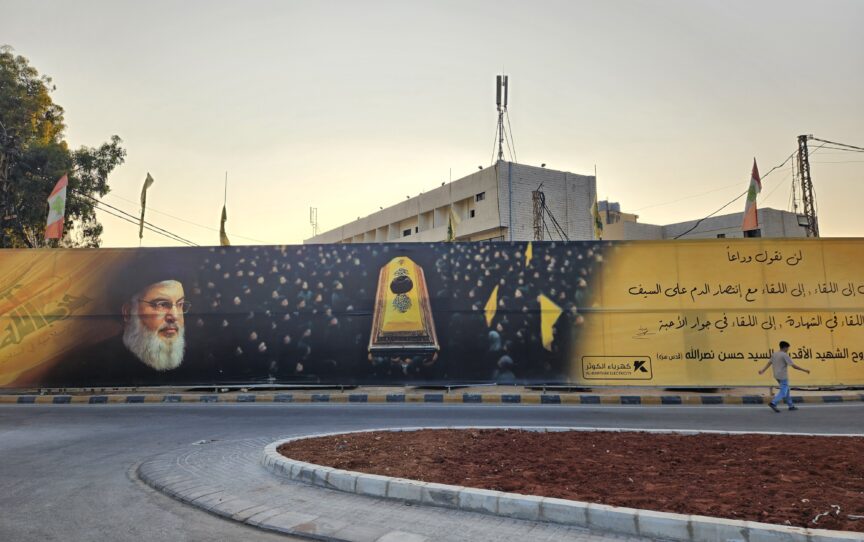
The Nasrallah shrine in Haret Hreik, Beirut. Credit: Julian Sayarer
Nevertheless, a spirit of resistance endures. While the Israelis mistakenly presumed that Hezbollah’s honouring a ceasefire meant it must have been destroyed, the contrary seems true. Defensive fire towards northern Israeli settlements has resumed, meaning the IDF’s bombing and ground invasion has carried costs. Ahron Bregman, a British-Israeli historian at King’s College London, who was recently in Tel Aviv for research and caught in the war, corroborates this view.
“This region poses military challenges due to its terrain,” Bregman explains. “Hezbollah inflicted many casualties when Israel deployed there between 1985 and 2000, and Israeli actions now play straight into Hezbollah’s hands.
“Its guerrillas are more familiar with the terrain and will launch attacks against the invaders, and Hezbollah now has an excuse not to disarm. It can say that while the Lebanese army is unable to confront the Israelis, Hezbollah can and should retain its weapons.”
Since October 2023, Israeli prime minister Benjamin Netanyahu, as well as the opposition with which he competes for a political spectrum of abject narrowness, have all championed Israeli reorientation around war under a brand of “super Sparta”, but society is straining under the psychological and economic fallout of its multifrontal extreme violence. Bregman’s reflections on the mood as Iran responded to US-Israeli attacks leave little hope of correction.
“I spent long hours with Israelis in shelters and was struck by their strong support for the government,” said Bregman. “This surprised me because people of Tel Aviv tend to be liberal, leftwing, and staunch opponents of Netanyahu. Yet, they support the war. It seems as though they have been brainwashed.”
While Israeli bombing has now displaced the southern population of Lebanon, prompting a nationwide housing crisis, the mountains of the south still constitute a fortress for Hezbollah. Its fighters have claimed the destruction of numerous Merkava tanks, and the IDF’s advance is floundering. The communities that sustain the struggle, as well as Lebanese youth – less sectarian than their parents’ generation, more instinctive in their support for Palestine – are unbowed before both Zionists and threats of a corrupt Lebanese state that might consider collaborating with them.
“If nobody truly cares about [Palestinians’] freedom, it doesn’t mean neither should we,” says Dayane, a young woman from a village in south Lebanon. “The Israelis are irredeemable and so is Zionism, and nobody can impose them on us. I know that us rising against this horror is inherently good for humanity.
“At some point, everyone has to look themselves in the eye and ask what is the purpose of being alive if they are to be so passive and so careless in the face of such horrible things being done?”
Dayane continues: “We are fighting it, despite the difference in capabilities, and because as a community we refuse to do nothing, or watch as 2.2 million people in Gaza are killed, and act like it is a circus, or a movie. For all this, despite the pain, yes, I am optimistic.”
From Novara Media via this RSS feed
5
6
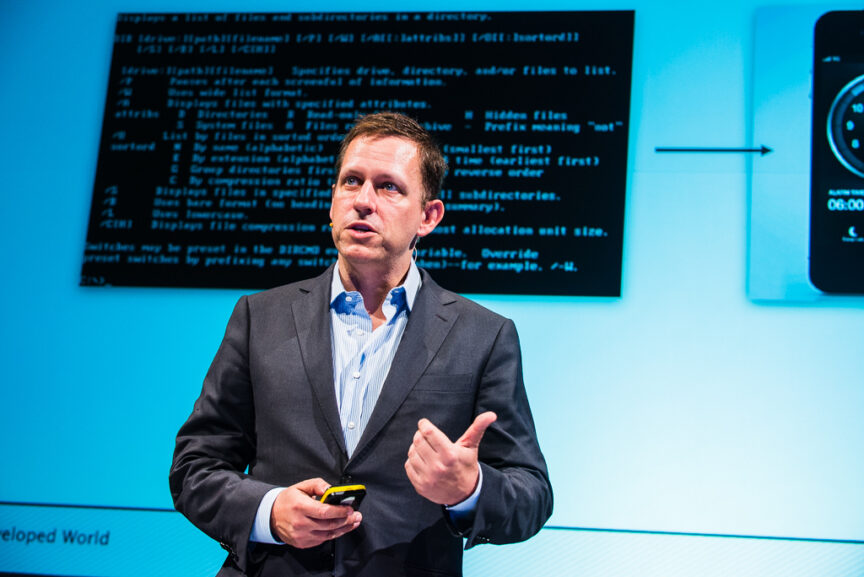
The controversial US spytech firm Palantir has been awarded a contract to analyse highly sensitive government data, despite loud opposition from campaigners decrying the firm’s role in abetting the Gaza genocide and the immigration crackdown in the US.
Palantir will be paid £30,000 per month to analyse highly sensitive data from the Financial Conduct Authority (FCA), raising questions about what the firm would do with that data – and why Palantir is ever more embedded in the British state.
The Miami-based firm already boasts contracts with the UK government worth over £500m, with its technology implanted in the NHS, the police and the military.
The latest contract – for which the government named only one, anonymised competitor – is part of the FCA’s drive to clamp down on rule-breakers amongst the 42,000 financial services firms it regulates.
Palantir will be given access to troves of financial data and asked to sort it, giving the company founded by billionaire Trump-donor Peter Thiel another view into the inner workings of the UK.
Speaking to the Guardian, an FCA insider asked: “Once Palantir understands how we detect money-laundering threats, how do we know that they are ethically reliable enough not to go to share that information?”
The multi-billion dollar company has built custom tools for ICE to help it identify targets for deportation in the US and announced a partnership with Israel for battle technology and “war-related missions” in January 2024.
Yesterday, MPs urged the Labour government to rethink the latest FCA contract.
Green party MP Siân Berry said: “Companies like Palantir should have no place within UK government systems when they are closely involved in President Trump’s illegal wars.”
The Greens’ leader, Zack Polanski, launched a campaign against Palantir this January, calling on the government to sever all contracts with the firm.
Martin Wrigley, a Liberal Democrat MP and member of the Commons technology committee, said: “We are creating a single behemoth that our UK firms won’t be able to compete against. We should be developing our own industries.”
The FCA said that Palantir would not control any sensitive data beyond the scope of the work it will be paid for – and when the contract ends, it will be forced to destroy any data and intellectual property it has seen.
Palantir said that it was proud to “support the FCA in their vital work to tackle financial crime”.
Sophia Sheera is a journalist in Novara Media’s social media team.
From Novara Media via this RSS feed
7
8
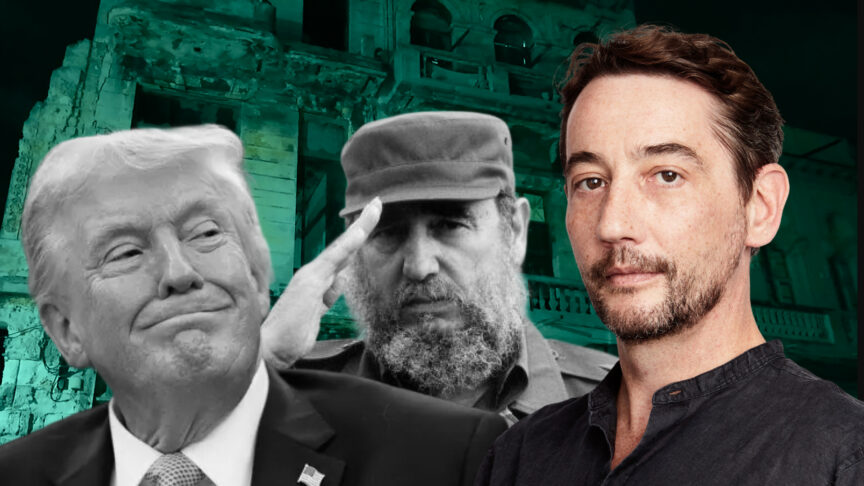
A senior Cuban government official tells us he leaves home without power and returns without power. His son cycles 14 kilometres to work, as an electrician, and comes home to a blackout.
This is life in Cuba right now. Not for ordinary citizens, but for the people running the country.
Novara Media’s Steven Methven reports from Havana on the crisis gripping the island: rolling blackouts, collapsing buildings, medicine shortages, and a US foreign policy decades in the making that has reached a new intensity under Trump.
From Novara Media via this RSS feed
9
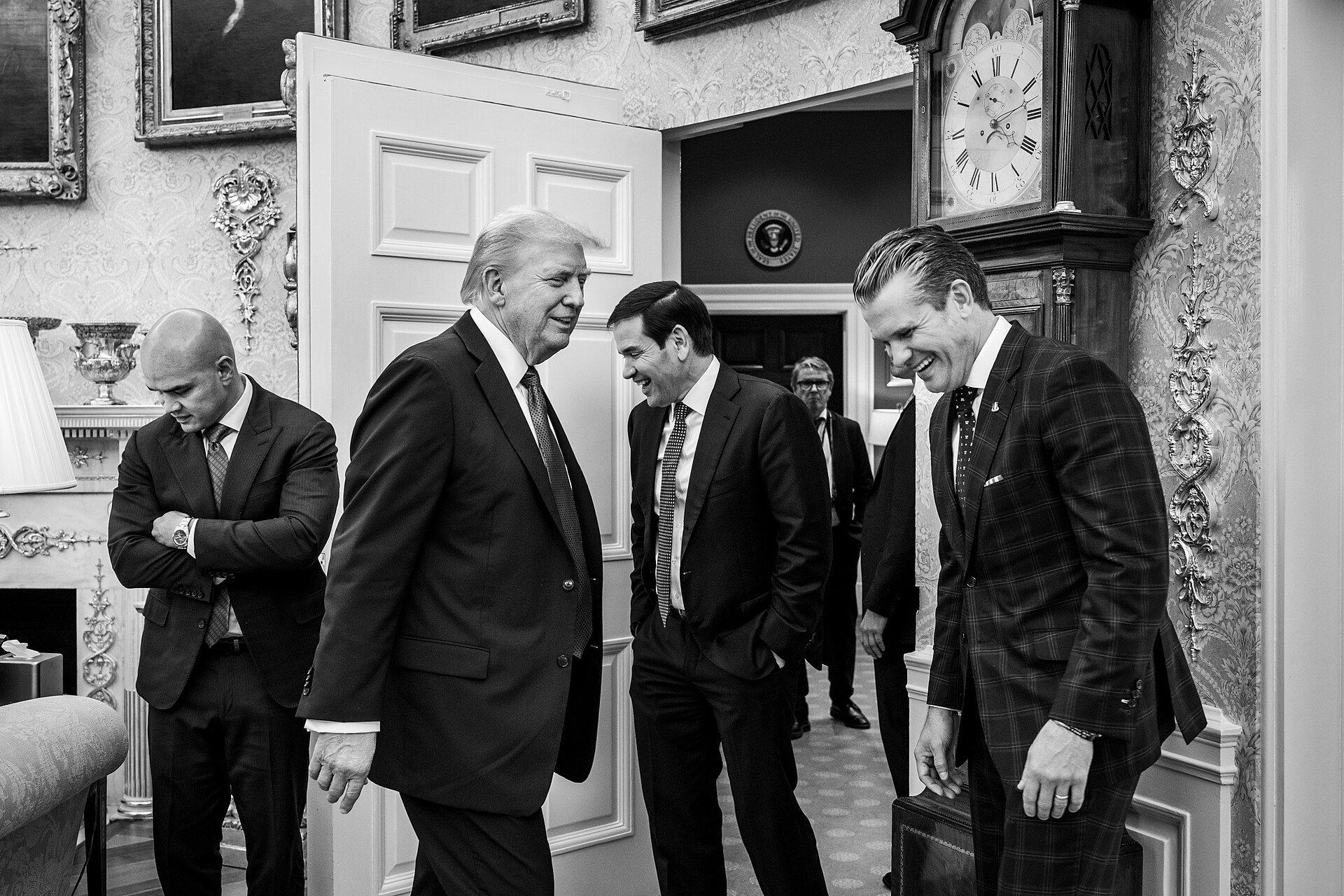
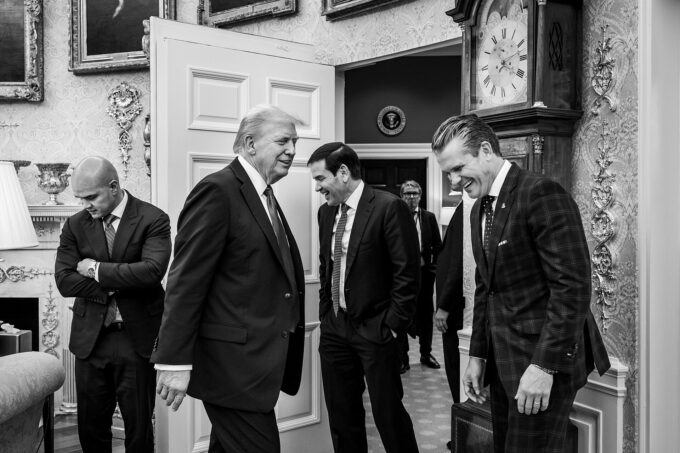
Photograph Source: The White House – Public Domain
Right at the launching of the US and Israeli war on Iran, itself a major war crime, the US fired a precision strike with a Tomahawk missile on an elementary school building. Some 160 girls aged 7-12 were killed, either by the powerful blast or by the collapse of the two-story concrete structure. Asked about the tragedy and slaughter of innocents, Commander-in-Chief Trump, after initially pleading innocence. He later suggested it was the Iranians, whose missiles he claimed “are often inaccurate.”
When later videos appeared showing the distinct image of a Tomahawk missile striking, he slithered over to another lie, calling the Tomahawk a “generic missile that many countries have bought and can buy.”
The truth? The Tomahawk is a US missile made in the US and is strictly controlled, and offered only to a few trusted allies like Britain and Australia.
Hegseth avoided Trump’s brazen lying by saying, “The Pentagon is investigating,” even as investigators said the gruesome slaughter was looking increasingly likely to have been the US’s fault. When that investigation finally concluded definitively that Pentagon targeters had been using eight-year-old maps that allegedly identified the building as an office for the Revolutionary Guard, though—whether true or not—neither “no mercy” Hegseth nor “no truth” Trump could not find it in themselves to express remorse or regret about the “mistake. ” Three weeks later, they still have not.
We saw the same callousness from both men in the case of the sinking of an Iranian Navy frigate by two torpedoes fired at the vessel off the southern tip of the island nation of SriLanka. As I wrote in an article on this site on March 7, the Dena was in an unusual situation: It was invited to participate in the MILAN Fleet Review, an annual event that brings together naval vessels, crews and officers of the navies of dozens of countries (this year there were 74 participating countries, including Iran and the US. At the time, the Dena set sail for and participated in joint exercises with vessels of other countries; the two nations were not fighting each other. In fact, the US, which did not send a ship to the event, but did send an admiral, as well as a P-81 Poseidon, a sophisticated sea patrol aircraft equipped to spot and track vessels, including submarines, over wide areas of ocean. That aircraft actually conducted an exercise with the Dena, a ship that it almost certainly already was tasked to sink once the US and Israel concluded their all-out war on Iran, no doubt picking up all kinds of useful knowledge about the Iranian ship’s capabilities, its radar and communications systems, etc.
Once the Fleet Review event had ended and the US-Israel assault on Iran had been launched, the Poseidon followed and tracked the Dena as it sailed towards a planned stop at a port at the southern end of Sri Lanka where, unknown to the Dena, a US nuclear fast attack sub, the Charlotte was waiting, submerged, with two huge torpedoes ready to sink the ship
The attack came without warning at 5:08 a.m. on May 4. No effort was made by the sub to notify the ship that it was a bout to be blown up, which the US sub could easily have done at a safe distance.
To make matters worse, after sinking the ship in two minutes with two torpedo hits, the US submarine left the scene of the attack. 87 sailors died in the attack, some certainly from the huge blasts, and some no doubt drowned while waiting two hours without flotation in the open ocean for rescue ships of the Sri Lankan Navy, moored 20 miles away, to arrive. Only 32 of the crew survived the attack, with over a dozen missing and presumed dead. The attack has been criticized as a “treacherous act,” given that the Dena was not in a war zone, had gone to an India-hosted event dedicated to “peace and friendship,” was likely not armed or only lightly armed because of an Indian stipulation that participating ships be unarmed, and because in any event there was no way the ship could have joined the battle with Iran’s military in the Persian Gulf, where US and Israeli air forces have total control of the air over Iran and the waters around it. The Dena would have had few choices but to remain in a safe harbor until that war ended (whenever that is!).
All Americans heard about this incident in their news reports on Dena’s destruction was Hegseth’s ugly boast: “This was never meant to be a fair fight, and it’s not a fair fight…We are punching them while they’re down, and that’s exactly how it should be.”
Except that abandoning injured enemy soldiers or sailors to die after a battle is over is a war crime.
It will be interesting to see what awards get handed out to the officers and crew of the Charlotte for this “heroic” naval engagement.
The post Trump and Hegseth: Two Soulless Men Devoid of Pity appeared first on CounterPunch.org.
From CounterPunch.org via this RSS feed
10
Photo by Saifee Art
A few days ago, I had the honor of participating in an international webinar organized by SHAPE—Serving Humanity and Planet Earth. As its name suggests, this project is focused on safeguarding humanity and the planet, and its acronym carries a meaningful symbolism: shaping. The theme I addressed, alongside distinguished figures such as Richard Falk, Joseph Camilleri, Chandra Muzaffar, and Helena Cobban, was Humanity on the Brink. The edge of the abyss, the total failure. Our aim was, in a sense, ‘Nietzschean’: to gaze into the abyss without allowing it to gaze back into us —without letting it pull us into its darkness.
This is an extraordinarily difficult task at a time when the United States and Israel are jointly entangled in a genocide that has now lasted two and a half years, while simultaneously engaging in aggression against Iran and Lebanon. Venezuela, too, is effectively under attack, and Cuba is subjected to what can only be described as a genocidal blockade.
The ambitions of the alleged “peace president” seem boundless; we follow and make record of his daily scandalous statements (each of them a breach of international law per se): “international law does not apply to me,” “I will bomb the Iranian island of Kharg just for fun,” “I can do whatever I want with Cuba.” The problem is that even a rational person becomes accustomed to such absurdities and begins to analyze them. But it’s hard to ignore a man who holds the power to press a “red button”. One never knows what he will say, nor what he might actually do, or how his actions will produce consequences far beyond those anticipated by him and his circle.
At the webinar, we spoke as intellectuals with conscience and genuine concern, drawing on knowledge and wisdom accumulated over decades. Yet we remained at Marx’s well-known insight: philosophers have only interpreted the world; the point, however, is to change it. In other words, we too remained at the first part, knowing full well that we could not arrive at solutions. As the Balkan poet and singer Balašević wrote, you cannot save the world with a song; neither can a webinar or intellectual engagement do much more than awaken someone. Still, I cannot suppress a sense of anger at the betrayal of the intellectuals, or more precisely, of academia. How is it possible that they remain silent? Why do they not organize petitions, issue declarations, or express solidarity with Palestin—or now with Cuba, Venezuela or Iran? The right to dissent seems increasingly reduced to a stark choice: keep your position and security, or risk losing both. Most choose the former.
In the discussion, I raised a question that some intellectuals have recently articulated: Are we already in the third world war? Jeffrey Sachs has repeatedly warned, including the members of the UN Security Council. Emmanuel Todd agrees. Others, however, dismiss this as alarmism and insist that we must still think in terms of avoiding the abyss. Jan Oberg is among those who advocate creative thinking grounded in “peace by peaceful means,” yet even he is not immune to despair in the face of each new catastrophic decision by Donald Trump or his government in Copenhagen. My interlocutors initially dismissed the question of what constitutes a “world war” (highly contested concept). What was the “world” at that time? Was it ever equally involved in the First and Second World Wars, or is this a Western tendency to universalize its own experience?
Richard Falk inspires with his calm, even in moments of despair: he rejects both pessimism and optimism, speaking instead of possibilism of doing whatever is useful for humanity in a given moment. In a private message after the webinar, he gently reminded me that the darkest hour comes just before dawn.
Yet when I raised the question of a new world war, I had something else in mind. Even Einstein did not know what weapons would be used. Yet we see that virtually anything can become one: water, food, tariffs, energy, artificial intelligence, fertilizers, and even the human mind. Everything is weaponized. Analyses increasingly suggest that the American empire is approaching its end. But I had a similar conversation 25 years ago with Håkan Wiberg, then director of Copenhagen Peace Research Institute, who was convinced the United States would eventually collapse. My question then—still unanswered—remains: what will be the cost in human lives? How many more wars, how many more children, how many more years?
The world is already at war—not in the classical interstate sense, but in a global economic, social, class sense of the word. And more importantly, every front is open simultaneously and in an increasingly brutal way. Each Trump’s move ‘just for fun’ costs billions taken from ordinary people. The same applies to the war in Ukraine and to the EU and NATO competing in how much they will allocate for warfare. The Ouroboros is devouring itself.
The aggression against Iran and Lebanon is paid for first by their peoples, but its effects spread in widening circles. Fear that fuel will become scarce, that supply chains will collapse, that economies will suffer, that small farmers will be crushed, that sanctions and blockades will lead to internal collapse and unrest—these are no longer hypothetical scenarios. In some places, they are already a reality.
I fear that this time, a war without rules—where everything is a potential weapon—will spare no one. We may not call it a world war, but it is certainly global. As Bertrand Russell said, war does not determine who is right, but who is left. Some see in this moment the birth pains of a new order; others hope for a global awakening that will break with the current system of hyper imperialism.
Trump, metaphorically speaking, only needs a long enough rope to hang himself. Around us, more and more ‘sleeping beauties’ are awakening. Even Europeans now say, “This is not our war,” though they failed to say so in earlier conflicts (1999, 2001, 2003, 2011, etc.)—or in the face of genocide. Instead, they remained silent and profited, as Francesca Albanese proved clearly.
What is most alarming is that some leaders seem more afraid of losing face and admitting military defeat than of using nuclear weapons. Those who have no taboo against genocide—would they really hesitate before crossing the nuclear threshold? On the other hand, perhaps those who hold real power (the oligarchy) fear only the loss of profit—and will prevent total self-destruction only because the war becomes too costly.
Nightmarish times—perhaps also times of rupture and awakening. Cassandra offers no clear prophesy. Yet.
This article was produced by Globetrotter.
The post Do We Recognize a Global War When We See One? appeared first on CounterPunch.org.
From CounterPunch.org via this RSS feed
11

Moya and Ash react to Louis Theroux’s documentary on the manosphere. The antics of YouTubers like HS and Sneako seem designed to amuse teenage boys and offend the normies – but when does the mask become the face? And who are the women who flock to these influencers? Plus: advice for a man who doesn’t want to dump his emotions on women.
Got a dilemma? Email ifispeak@novaramedia.com
Join us at Crossed Wires festival in Sheffield on 4th July.
Music by Matt Huxley.
From Novara Media via this RSS feed
12
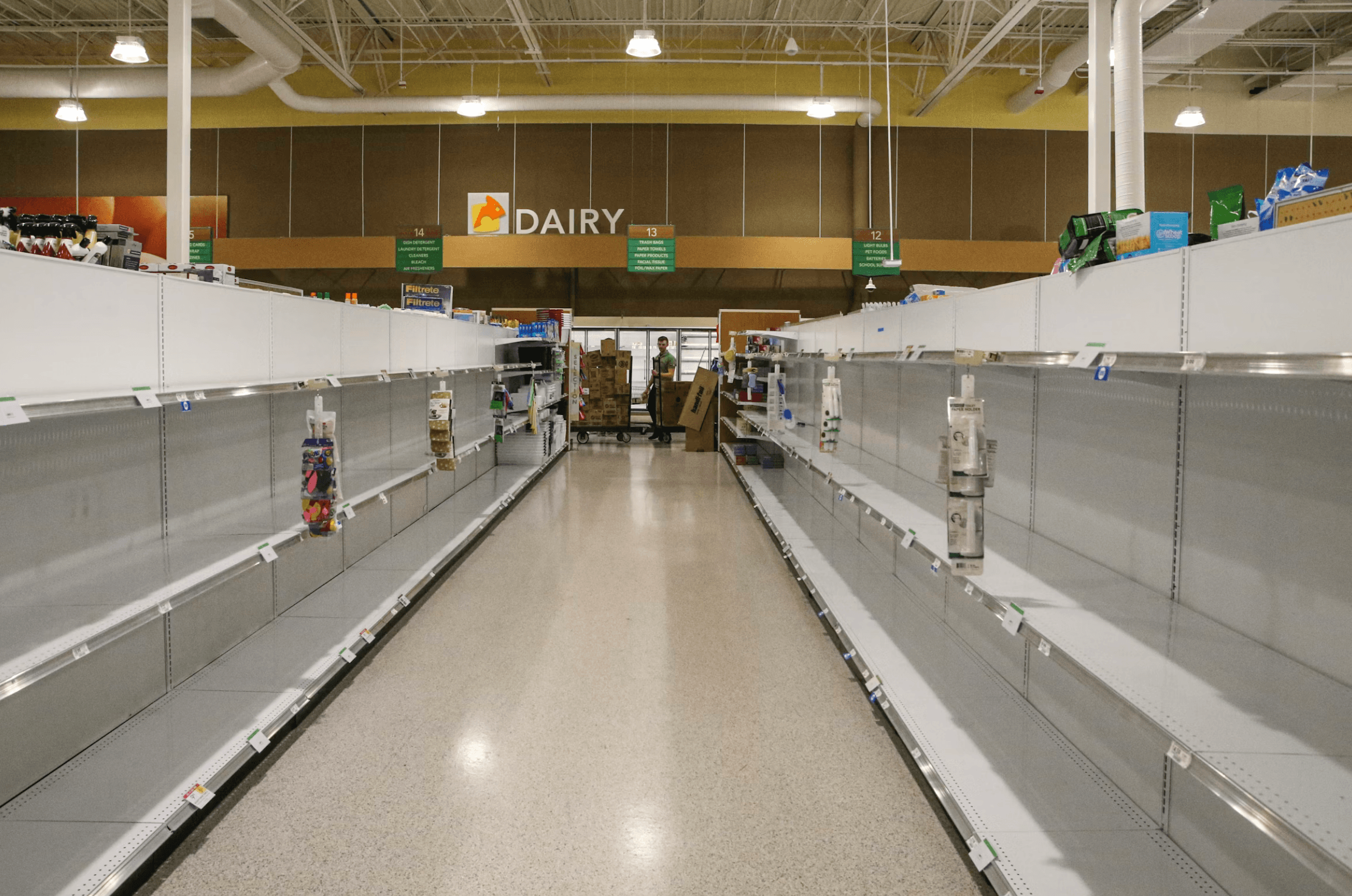
Photo by Mick Haupt
Kiran unlocked her dosa shop in Bangalore before sunrise, a morning routine she had followed for many years. Only, this time she was not able to open for business. The price of gas had surged again, and deliveries of a LPG cylinder had become uncertain. Thousands of kilometers away in Meru, Hassan postponed harvesting his crop due to rising diesel prices. In Berlin, Anna has begun lowering the heating to cope with rising energy bills.
These stories may appear unrelated. In reality, they are increasingly tied to a single geopolitical fault line: the escalating confrontation between Israel/United States and Iran in the Gulf.
At the center of this emerging global ripple effect lies the Strait of Hormuz, a narrow maritime corridor between Iran and Oman linking the Gulf to global markets. Roughly a fifth of the world’s oil supply passes through this waterway every day, making it one of the most strategic chokepoints in the global economy. Any disruption in shipping through the strait quickly reverberates across energy markets by raising prices, causing supply disruptions.
But energy shocks do not stop at the gas pump. They travel rapidly through the global food system challenging global food environment.
Industrial agriculture is highly dependent on energy supplies. Fuel powers tractors and irrigation systems. Natural gas is essential for producing nitrogen fertilizers that sustain crop yields worldwide. Shipping networks transport grains, animal feed, and agricultural commodities and inputs across continents. When energy prices surge or transport routes become unstable, food production and distribution costs inevitably rise.
Early signs of such pressures are already emerging. Shipping companies are reassessing routes through the Gulf as security risks increase, pushing up insurance premiums and freight costs. The World Food Programme is mobilizing to secure the flow of humanitarian emergency food aid despite increasingly insecure logistics networks. This fragility is illustrated by 21,000 metric tons of wheat stranded at the Port of Salalah in Oman, which has recently been struck allegedly by Iranian drones.
Disruptions are already producing economic effects across regions. In India, rice prices have fallen as export shipments pile up due to disrupted routes, while LPG shortages are affecting restaurants, hotels, transport and manufacturing industries, given that around 80 percent of ıts LPG imports normally pass through the Hormuz.
Iran’s Islamic Revolutionary Guard Corps recently announced strikes against oil tankers linked to the United States. A Thai-flagged bulk carrier was also reportedly targeted. At the same time, Tehran appears to be applying selective trade restrictions, that spare certain countries, underscoring how geopolitical tensions can rapidly reshape global trade flows.
Consumers in the Gulf are already suffering from the impacts of war on food shortages. In the United Arab Emirates, shoppers have reported rising prices for fruits and vegetables amid disruptions linked to the regional conflict, while in Kuwait, local fish markets have been affected. Ranking among the top 50 countries worldwide in food security, Gulf countries maintain significant food reserves to ensure availability and affordability, but nevertheless remain heavily dependent on imported food supplies. Since the Saudi-led blockade in 2017, Qatar has invested heavily in domestic food production and strategic food reserves, strengthening its resilience, though the region remains exposed to shocks in global energy and shipping systems.
The world has already experienced how Covid 19 pandemic and war in Ukraine destabilized the global food systems. When Russia invaded Ukraine in 2022, the conflict quickly evolved into a global food crisis. Ukraine and Russia together accounted for 30 percent of global wheat exports, and fighting disrupted shipments from ports along the Black Sea. Grain prices surged, placing enormous pressure on food-importing countries across North Africa and the Middle East.
Diplomatic intervention eventually helped mitigate that crisis. The Black Sea Grain Initiative, mediated by the United Nations and Türkiye, reopened shipping corridors and helped stabilize global grain markets for several months. The episode demonstrated how conflict in a single region can rapidly trigger global food insecurity.
Yet the emerging Gulf crisis differs from the Ukraine war in one crucial respect.
The Ukraine conflict created a grain chokepoint by blocking the export of specific agricultural commodities. A prolonged war in the Gulf, by contrast, could trigger an energy crisis that affects the entire infrastructure of global food production. The Strait of Hormuz is a strategic site as industrial food system is addicted to fossil fuels. Energy prices shape every stage of the food supply chain, from fertilizer manufacturing to harvesting, processing, and transportation. These factors makes the global food system vulnerable to any disruption that interrupts the movement of supply chains, not only wars but also climate shocks, pandemics, and tariff disputes.
This is especially significant for fertilizer markets since the Gulf is responsible for major global fertilizer pruduction and trade including 20 percent of phosphate, 25 percent of sulfur, and nearly 49 percent of urea. Fertilizer shortages could reduce crop yields in future harvests. If instability around the Hormuz continues, farmers from India, China, Brazil, among others, could face higher production and trasportation costs. According to WFP, roughly 45 million more people could be pushed into acute hunger this year, driving global food insecurity back to levels seen at the onset of the Ukraine war, with import-dependent countries in Africa and Asia facing the sharpest rise in risk.
The most vulnerable consumers – smallholder farmers, rural communities, and people living under occupation and food insecure places will suffer the most from this distant war, even though they might have never heard of the Strait of Hormuz.
Ensuring a just, equitable and sustainable food system is possible as solutions are presented in a number of United Nations reports, scientific publications, and promoted by several NGOs: Prioritizing local food systems, promoting national food sovereignty; implementing right to food in national justice systems; supporting agroecological farming methods rather than relying heavily on synthetic fertilizers and chemicals. In uncertain times, diversifying food systems and empowering local producers may prove more resilient than relying on highly concentrated agribusiness networks.
The post From the Bosphorus to Hormuz: How Two Straits Shape the Global Food Crisis appeared first on CounterPunch.org.
From CounterPunch.org via this RSS feed
13
7
Vance to Attend Billionaire-Hosted Fundraisers as Iran War Worsens Cost Crisis, Hunger
(www.commondreams.org)
14
Photograph Source: Office of the Director of National Intelligence – Public Domain
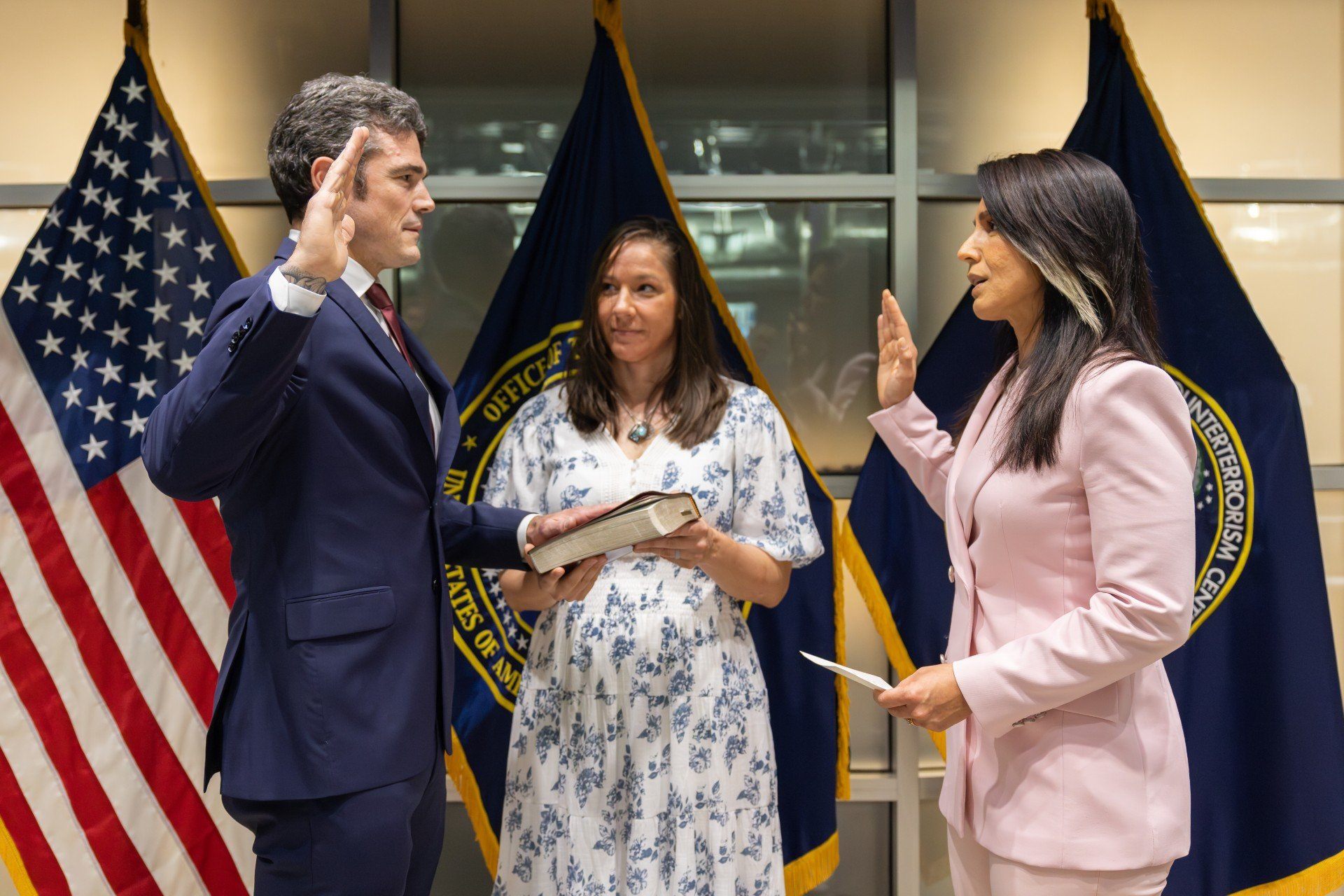
Joe Kent, the now former US Director of the National Counterterrorism Center, always seemed a bit off, especially to liberals. As a combat veteran of MAGA pedigree, he found favour with President Donald J. Trump, who rewarded him for his conspiracy blustering in a manner befitting other nominees baptised in the truth repelling River of Fox News. But the mindless adventurism in attacking Iran in league with Israel was a step too far.
In his resignation letter, Kent asserted that he could not “in good conscience support the ongoing war in Iran. Iran posed no imminent threat to our nation, and it is clear that we started this war due to pressure from Israel and its powerful American lobby.” Till June 2025, the President had “understood that the wars in the Middle East were a trap that robbed America of the precious lives of our patriots and depleted the wealth and prosperity of our nation.”
Then came the machinations of “high-ranking Israeli officials and influential members of the American media” with their “misinformation campaign that wholly undermined your America First platform and sowed pro-war sentiments to encourage a war with Iran.” From there came the “echo chamber” that deceived Trump “into believing Iran posed an imminent threat to the United States, and that should you strike now, there was a clear path to a swift victory.” The same tactics had been used by Israel in drawing the US “into the disastrous Iraq War that cost our nation the lives of thousands of our best men and women.”
Israel comes in for a further lashing for having left its personal mark on Kent’s life. “As a veteran who deployed to combat 11 times and as a Gold Star husband who lost my beloved wife Shannon in a war manufactured by Israel, I cannot support sending the next generation off to die in a war that serves no benefit to the American people nor justifies the cost of American lives.”
The portrait of Kent is an unremittingly spiky and jarring one. Even before the resignation, he was already under investigation by the FBI’s criminal division for alleged leaks of classified information, which should commend him to the fifth estate. (Such leaks in any administration, and most certainly one like the Trump administration, should be treasured, not abominated.) Former deputy White House chief of staff Taylor Budowich was of the view that Kent was “often at the centre of national security leaks” and “spent all his time working to subvert the chain of command and undermine the President of the United States”.
The language of the resignation note was also bound to stir the blood of those willing to see antisemitism rearing its vast, deformed head. This was made easier given Kent’s checkered history, a point made by the Anti-Defamation League (ADL) and the Southern Poverty Law Center (SPLC) during last year’s confirmation hearings on Capitol Hill. In a February 2025 statement, the ADL noted his tendency to promote “multiple conspiracy theories” and forge links “with individuals who have extremist ties, including to groups such as the Proud Boys, Groypers and Three Percenters, some of which have a history of violence.”
In a June 2025 joint letter authored with the Western States Center, the SPLC similarly noted a past heavily salted with conspiracy theorising and links to right wing extremism and white supremacists. Kent had not only “embraced discredited anti-government conspiracy theories – including that the FBI and the intelligence community were involved in the January 6, 2021 deadly attacks at the US Capitol” but had “connections with bigoted individuals, far right violent extremists, and anti-democratic movements”. He had, for instance, discussed social media strategy with the white nationalist and antisemite Nick Fuentes and conducted an interview with Greyson Arnold, a live streamer who thought Hitler “a complicated historical figure which many people misunderstand”.
The ADL and the American Israel Public Affairs Committee (AIPAC) who nakedly operate as open fronts of Israeli opinion, were bound to play the ad hominem game in attacking the man over opinion. According to the ADL, Kent’s letter trafficked “in old-age antisemitic tropes”. It was hardly a “surprise that he would blame Israel and the media for pushing the President into war against the Iranian regime.” Refusing to consider the pathological lunacy underlying the pre-emptive war on Iran, Ilan Goldenberg of the liberal pro-Israel advocacy group J Street could only see “ugly stuff that plays on the worst antisemitic tropes”.
These inane airings are unsurprising. The ADL refuses to acknowledge the sheer depth of Israeli involvement and support in the US political and religious establishment, much of it unhealthy and a good deal of it undemocratic. Suggestions that Israel might be distorting the perspective of US strategists and policy makers are shouted down in frothing fury. The organisation can barely stomach the term “Israel lobby”, something evidenced in the organisation’s travesty of a review of a work bearing that name by John J. Mearsheimer and Stephen M. Walt. Here was, in the words of the ADL’s unlettered hatchet job, “a classical conspiratorial anti-Semitic analysis invoking the canards of Jewish power and Jewish control.” Unmissable here is that Mearsheimer and Walt had, like Kent, also noted the poisonous hold Israel had exerted over the Washington establishment in encouraging the pre-emptive, illegal war waged against Iraq in 2003. The lie of the imminent threat has some form.
Kent also had another handicap from the past that was bound to be exploited by the administration. On that platform of handy bile and venom called Truth Social, Trump posted a tweet from January 2020 in which Kent encouraged attacking Iran. “We should not sit and wait for the next attack, wipe Iran’s ballistic capability out and get our troops out of Iraq – they are only targets now.” The post on what was then Twitter was made in the aftermath of Trump’s order to assassinate the Iranian commander of the Quds force, General Qassem Soleimani. “No US WIA/KIA is a tribute to the professionalism of our military and intel professionals not Iranian restraint.”
As the letter itself indicates, Kent may have changed his mind. He even acknowledged that Soleimani’s assassination was a decisive application “of military power without getting us drawn into never ending wars.” (MAGA is for slaying foreign officials, as long as the operation is scrupulously limited.) For the dogmatist followers of the Trump MAGA brand, something deeper is underfoot. The prospects for conscientious objections to the war by service members reluctant to serve in the conflict have also improved. Prolonging the absurd, illegal, and increasingly catastrophic war against Iran will prove telling in that regard. And just because it is deemed such by a person as sketchy as Kent is hardly a reason to ignore the premise.
The post Tremors in MAGA: Joe Kent, the Iran War and the Antisemitism Smear appeared first on CounterPunch.org.
From CounterPunch.org via this RSS feed
15
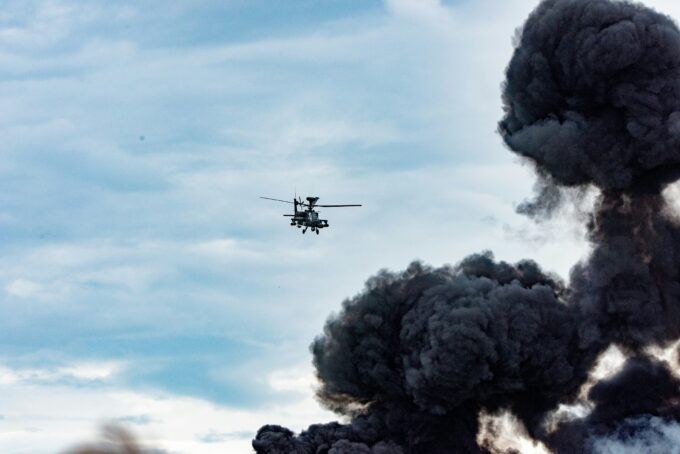
Image by Daniel Klein.
US President Donald Trump did not invent the phrase “fake news,” but he undoubtedly transformed it into a political weapon, relentlessly accusing critical media of fabricating unfavorable narratives.
The deeper irony, however, is harder to dismiss. Trump himself has exhibited a persistent disregard for factual consistency. Whether he believes his own claims is ultimately beside the point; what matters is that his record has eroded any reasonable basis for trust.
His war on Iran illustrates this contradiction with striking clarity. Trump has repeatedly spoken of his commitment to a negotiated resolution with Tehran. Yet, at critical junctures—often in tandem with Israeli Prime Minister Benjamin Netanyahu—his administration has moved toward escalation, authorizing or supporting strikes even as diplomatic language dominated public discourse.
This is not an isolated contradiction, but a pattern.
Prior to the US-Israeli escalation in June 2025, Washington projected sustained optimism regarding diplomatic progress with Tehran, with messaging centered on possible agreements and ongoing indirect negotiations, reportedly facilitated by regional intermediaries such as Oman.
Yet, during and immediately following this period of diplomatic signaling, the United States and Israel proceeded with large-scale military strikes on Iranian targets, effectively collapsing the very negotiations that had been publicly emphasized.
The same pattern repeated itself on February 28, 2026. In the days leading up to the escalation, and even as discussions were believed to be underway through indirect channels, Trump continued to speak of potential deals and positive diplomatic momentum. However, these signals were swiftly overtaken by coordinated military action, reinforcing the perception that negotiations had once again functioned as a strategic cover for escalation rather than a genuine attempt at resolution.
Prior to earlier escalatory phases, Washington signaled that diplomatic channels remained active, reportedly through intermediaries such as Oman. At the same time, however, the US was expanding its military footprint in the region. The outcome was predictable: negotiations provided the appearance of restraint, while preparations for confrontation proceeded uninterrupted.
A similar sequence unfolded again in late February. Renewed talk of diplomacy coincided with fresh military action, reinforcing the same cycle—dialogue, deadlines, escalation.
Trump has repeatedly issued ultimatums, only to revise, extend, or abandon them altogether. Negotiations, in this framework, are not a pathway to resolution but a strategic instrument—used to buy time, reposition forces, and maintain the initiative.
Iran appears to have recognized this dynamic.
In the earlier phase of escalation, in June, Iranian retaliation was relatively delayed, taking approximately 18 hours to fully materialize following the initial strikes. However, after the February 28 aggression, Iran’s response was significantly faster, occurring within approximately two hours, and was more coordinated in both scale and targeting.
This contrast suggests not only improved operational readiness, but also a clearer strategic understanding of Washington’s use of negotiations as a tactical cover for escalation.
In earlier phases of the conflict, Tehran’s responses were slower, more cautious, and calibrated to avoid uncontrolled escalation. More recently, however, its reactions have become faster and more synchronized, suggesting both increased readiness and a clearer reading of Washington’s strategy.
Now, Trump appears to be returning to the same playbook.
In a recent post on Truth Social, he stated: “I have instructed the Department of War to postpone any and all military strikes against Iranian power plants and energy infrastructure for a five-day period, subject to the success of the ongoing meetings and discussions.”
He further described the talks as “very good and productive” and claimed that there were “major points of agreement” between Washington and Tehran, despite Iranian officials publicly denying that any direct or indirect negotiations are taking place.
Taken at face value, such remarks might suggest a rational recalibration. The broader context certainly allows for that possibility. The war has not gone according to plan.
Iran has demonstrated notable political cohesion, military resilience, and social endurance. Despite sustained attacks on infrastructure, the killing of civilians, and the targeting of senior leadership, the state has maintained strategic continuity. Its responses have not only absorbed pressure but reshaped the battlefield, raising the cost of escalation for its adversaries.
In doing so, Iran has effectively countered what we previously described as Israel’s “gone wild” doctrine and Trump’s so-called “madman” posture—two overlapping strategies rooted in unpredictability, escalation dominance, and psychological pressure. Rather than being destabilized by this approach, Tehran has absorbed it, adapted to it, and ultimately neutralized its intended effect. What was meant to overwhelm has instead been contained, gradually shifting the strategic balance.
What began as an asymmetric confrontation has evolved into a more balanced, and therefore more dangerous, strategic equation.
Iran is no longer merely reacting—it is shaping outcomes.
Meanwhile, diplomatic activity has intensified. Although Tehran denies direct negotiations with Washington, there is little doubt that indirect channels are active. Regional mediation efforts are reportedly involving actors such as Oman, Türkiye, and Egypt, pointing to a complex and multi-layered diplomatic track.
In this light, Trump’s statements could be read as an attempt to create an exit from a war that is steadily turning into a political and military liability. With midterm elections approaching, the domestic cost of a prolonged and inconclusive conflict cannot be ignored.
But Trump and the Gramscian notion of “good sense” rarely intersect.
His record suggests a different interpretation—one in which diplomatic language serves as a tactical cover rather than a strategic shift.
Recent developments reinforce this concern. US and Israeli officials have reportedly explored options involving high-value strategic targets, including Kharg Island in the Persian Gulf, Iran’s primary oil export terminal, where reports suggest possible US consideration of blockade or seizure operations to pressure Tehran over the Strait of Hormuz.
Trump himself has repeatedly threatened Iran’s energy sector, warning that the United States could “obliterate” Iranian power plants and energy infrastructure if Tehran failed to comply with US demands, including reopening the Strait of Hormuz.
At the same time, the inconsistency of Trump’s ultimatums continues to undermine any perception of credible negotiation. Deadlines are imposed, revised, extended, or abandoned with little coherence, reinforcing a sense of calculated unpredictability.
It is therefore entirely plausible that the current overture is not a step toward de-escalation, but a familiar maneuver—designed to manage perception, buy time, and prepare the ground for another phase of confrontation.
Iran, however, is unlikely to be caught off guard again. While the specifics of any forthcoming action may remain unclear, its increasingly rapid and calibrated responses suggest a high level of strategic anticipation.
What is particularly revealing is the parallel messaging emerging from Israeli officials, who have begun to suggest that the war may be nearing its conclusion and that a mutually beneficial agreement is within reach.
This alignment is unlikely to be coincidental. It points instead to a coordinated narrative—one that may serve purposes beyond diplomacy itself.
Whether this signals genuine de-escalation or a prelude to further escalation remains uncertain.
What is already clear, however, are several critical facts: the US-Israeli war effort has encountered serious limitations; Iran has emerged in a far stronger position than anticipated, with tangible leverage in any negotiation; and, ultimately, Trump’s words—no matter how measured or conciliatory they may appear—cannot be taken at face value.
The post Talks, Then Bombs: Is Washington Rehearsing the Same Trap on Iran? appeared first on CounterPunch.org.
From CounterPunch.org via this RSS feed
16
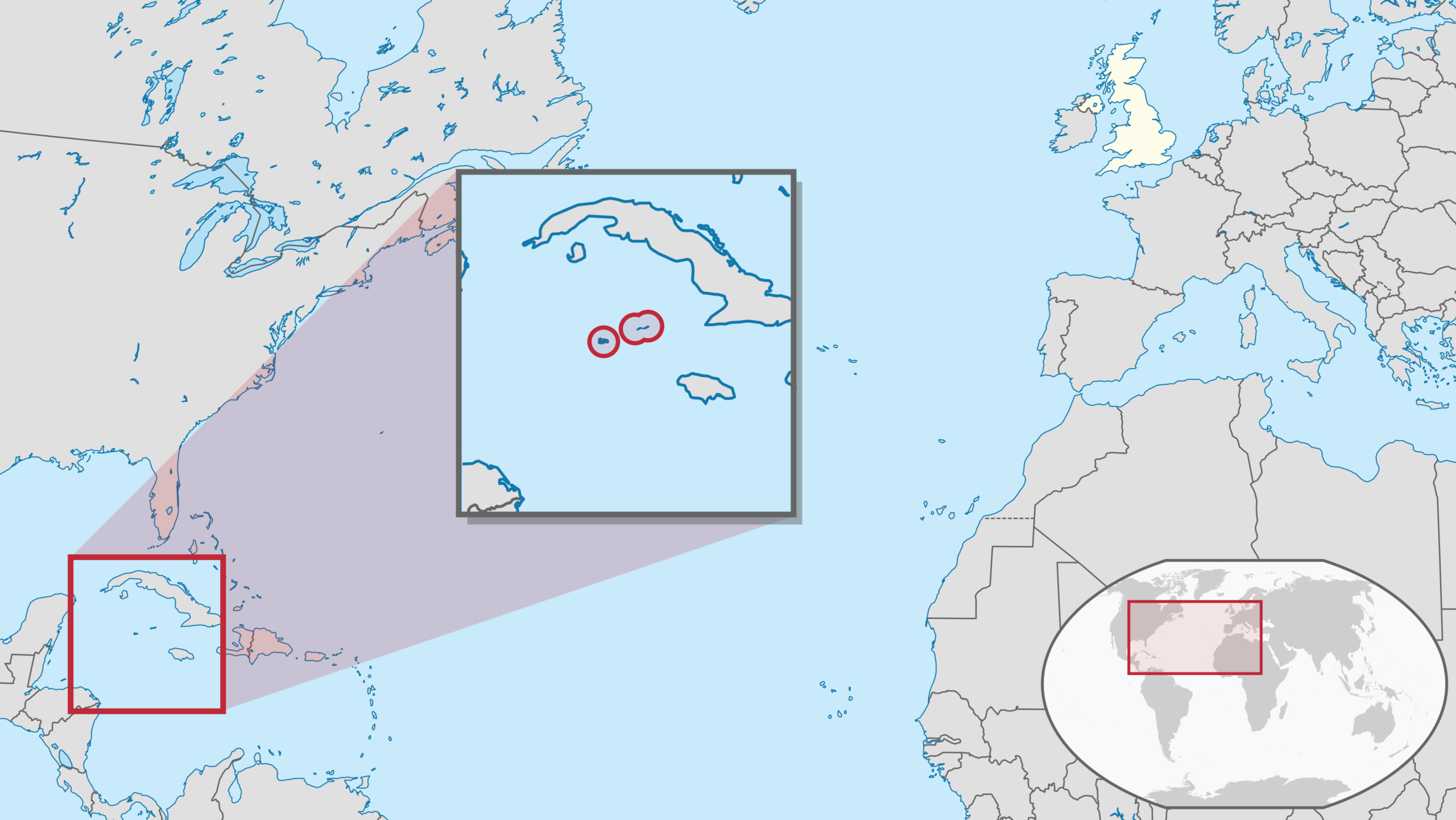
Image Source: TUBS – CC BY-SA 3.0
China, which was the largest holder of U.S. government debt as recently as 2019, has cut its holdings to the lowest level since 2008, driven by changing trade patterns, geopolitical concerns, and domestic economic pressures.
The Cayman Islands has emerged as an unlikely place to fill the gap. This small British overseas territory held $427 billion in U.S. Treasuries as of November 2025, making it the sixth-largest foreign holder. But a 2025 Federal Reserve analysis revealed that the total figure was actually closer to $1.4 trillion by the end of 2024—with some estimates reaching as high as $1.85 trillion—after nearly 40 percent of new treasury notes and bonds were purchased in the Cayman Islands after 2022.
While these figures suggest that the territory is the largest foreign holder of U.S. debt, the main buyers are not Caymanians or the government, but hedge funds. After the territory passed its Mutual Funds Law in 1993 amid the 1990s hedge fund boom, these vehicles began incorporating in large numbers, drawn by flexible regulation and low taxes. The Cayman Islands today is home to roughly three-quarters of the world’s offshore hedge funds.
Many have used so-called “basis trades,” borrowing heavily to profit from small price gaps between U.S. Treasury bonds and their future equivalents. The strategy has grown so large and opaque that it has triggered a Federal Reserve investigation.
Emergence and Evolution of a Financial Hub
The Cayman Islands has played a major role in global finance since the 1960s, operating as a center for tax evasion and asset parking. Mostly European banks trading in dollars outside the U.S., nicknamed Eurodollars, could lend these dollars beyond the reach of American regulations and capital controls. As the market grew, the Cayman Islands became a central place to store and use these Eurodollars.
Local Cayman lawmakers also passed financial laws to attract international businesses in the 1960s, including having no direct taxes on individuals, corporate profits, or capital gains, which helped cement the islands’ role as an offshore financial center. The legal system, based on English common law, offered clear rules, modern legislation, and independent courts. Packaged into a simple, finance-focused framework, it gave investors confidence and turned the territory into a quiet financial powerhouse.
Despite the Cayman Islands’ own elected government led by a premier, key powers remain with the United Kingdom. Final appeals in major cases are heard in London, while a governor appointed by the British monarch, on the advice of the British government, oversees internal security and coordinates foreign affairs with London. In theory, Britain can also intervene in the territory’s governance, providing a level of political stability valued by outside investors.
The Cayman Islands’ success has come from a “collaborative policymaking process that involved local leaders, expatriate professionals, and British officials,” according to a working paper by the University of Alabama, along with embracing financial trends. Home to more than 120,000 companies as of 2025, including thousands registered at the five-story Ugland House, hedge funds are just one of several recent financial booms. The parent company of Theleme Partners LLP, a hedge fund linked to former UK Prime Minister Rishi Sunak, “lists the notorious Ugland House as its address. The small office is the registered home to approximately 40,000 entities,” stated the Good Law Project.
In 2022, the bankruptcy of cryptocurrency exchange FTX exposed billions in missing customer funds and became one of the largest financial frauds of the decade. Court filings showed that more than a fifth of its registered customer accounts were from the Cayman Islands—greater than any other jurisdiction—highlighting how easily new and risky ventures could be structured.
The territory also plays a central role in shadow banking. After banks pulled back from lending following the 2008 financial crisis, non-bank loans and financing surged, and many such funds have been domiciled in the Cayman Islands, such as Blackstone’s iCapital Offshore Access Fund SPC.
The Cayman Islands were also central to the 2020–2021 boom in special purpose acquisition companies (SPACs), which raised capital through IPOs to merge with private firms and take them public. Of the more than $100 billion raised in 2021, half of the SPACs were Cayman-incorporated. Rising interest rates and increased regulatory scrutiny slowed the expansion, but SPAC activity in Cayman has seen a resurgence since 2024.
It also sits at the center of China–U.S. capital markets. Because Chinese law restricts foreign ownership in certain industries, many Chinese firms list abroad via Cayman holding companies using variable interest entity (VIE) structures. This includes giant Chinese e-commerce company Alibaba, whose ultimate parent company is incorporated in the Cayman Islands.
The scale is remarkable, with Cayman-registered investment funds holding more than $8 trillion in assets by the end of 2023, in a territory with a population of less than 80,000 people.
London and Other Jurisdictions
The Cayman Islands are part of a wider network of British-linked financial jurisdictions. According to Global Financial Integrity, “The UK’s offshore tax havens are estimated to facilitate nearly 40 percent of the tax revenue losses suffered annually by countries around the world.”
[Content truncated due to length...]
From CounterPunch.org via this RSS feed
17
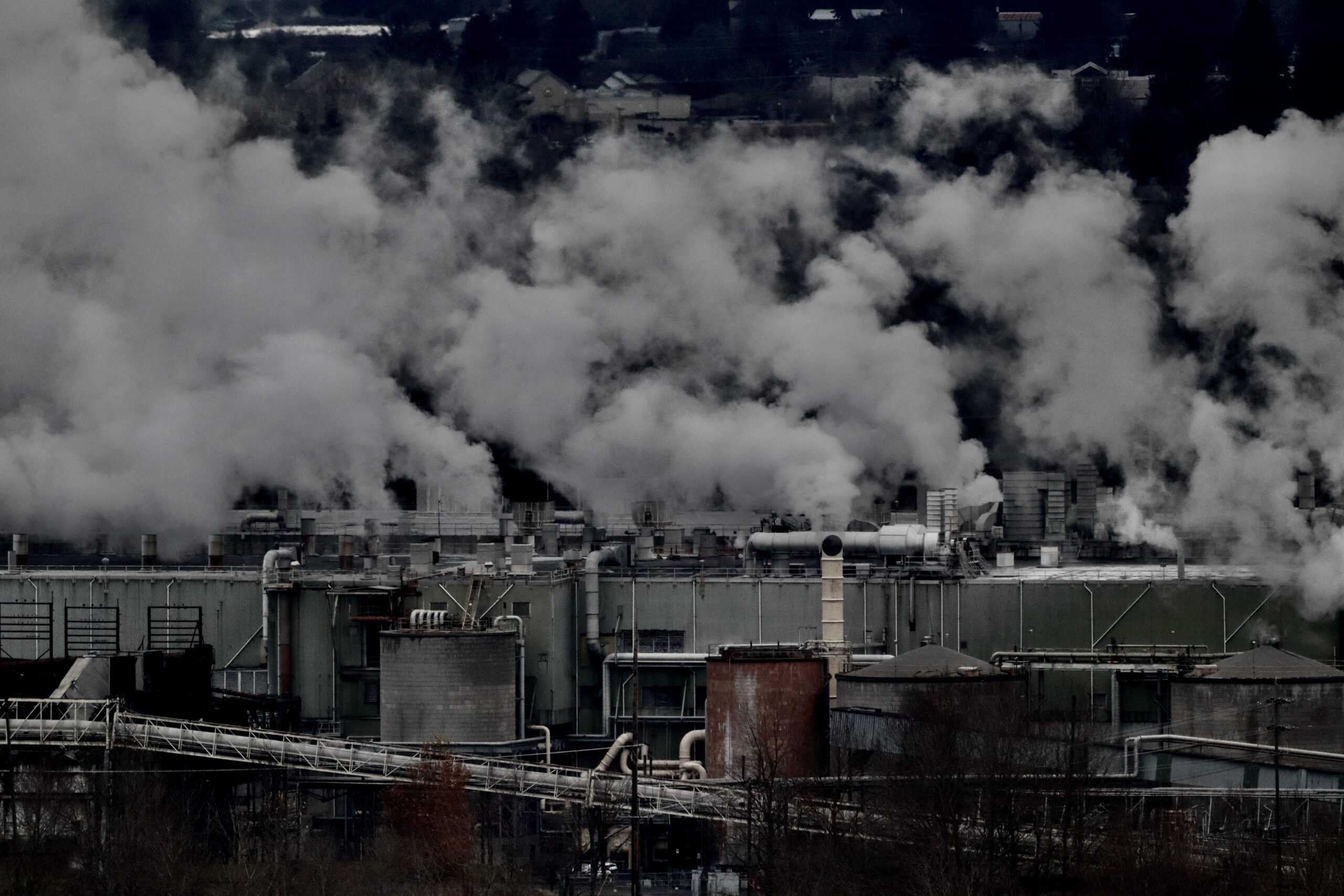
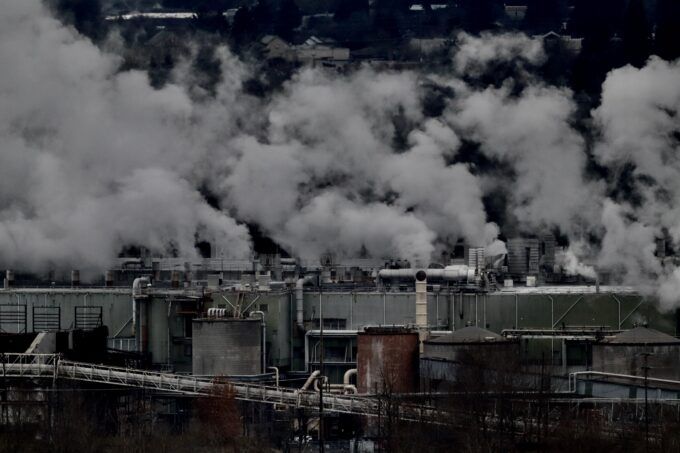
Longview, Washington. Photo: Jeffrey St. Clair.
To combat climate change, the entire world has to make the transition away from fossil fuels. If a major emitter like the United States or India doesn’t substantially reduce its emissions, it will doom the entire enterprise. As never before in human history, richer and poorer must work together.
But what will that joint action look like?
The industrial revolution, which coincided with peak colonialism, enriched the Global North at the expense of the Global South. In the process of spewing out vast quantities of greenhouse gasses, richer countries also racked up an enormous climate debt beginning in the nineteenth century. Now, the richer countries—and the richest individuals wherever they might live—must pay back this debt by funding the clean energy transition of poorer communities.
Paying reparations in this way is not just an act of justice. It is indispensable to the saving of the planet.
In theory, that’s what the Just Energy Transition Partnerships are all about. South Africa’s JET-P, for instance, is designed to finance the country’s shift away from coal-fired power plants to renewable sources of energy. Currently, 83 percent of South African electricity is generated by fossil fuels, with 58 percent coming from the dirtiest source, coal.
The JET-P for South Africa, which it launched with a consortium of richer nations in 2021, has marshaled around $12.4 billion. This money has been earmarked for building out solar and wind capacity, expanding the electricity grid to support that buildout, and setting up programs for retraining workers, particularly those in the coal sector.
“It’s a big fund,” notes University of Johannesburg sociology professor Patrick Bond, “and it should allow us to close down our coal-fired power plants early. And to the extent that we need to import turbines for wind or solar panels and batteries and inverters, then we can make that transition.”
After five years, however, the project is still in its early stages.
“We are talking about replacing 88 coal-fired power units that produce just under 50GW of electricity,” explains Roland Ngam, Project Manager for Climate Justice at the Rosa Luxemburg Stiftung’s South Africa office. “If it has taken a half decade just to put the bureaucracy in place, you can imagine how long doing the brick-and-mortar work will take. Replacing these coal-fired units and expanding green capacity also means laying 14,000 kilometers of high-voltage transmission lines – and that will cost $26 billion to complete. If we throw the global political climate into the mix, one begins to see how this thing can take at least a few decades to complete.”
It’s not just the timeline that’s problematic. Most of the funding comes in the form of loans—92 percent—rather than grants. And while the interest rate for the loans is rather low, it still adds to the country’s already sizable debt burden of around $350 billion. South Africa spends nearly $22 billion each year just to service that debt, which is considerably more than what the government spends on public health. Also, the outlays so far have gone to “the consultancies,” Patrick Bond adds, “these big firms, the KPMGs, the Ernsts and Youngs, all the big boys who do this work, instead of local environmental justice groups.” He points out that the same firms were complicit in looting the South African state by facilitating widespread corruption in the 2010s.
There are ways to push the JET-P more in the direction of climate justice. “For example, rural populations should be empowered with the infrastructure and funds to set up microgrids,” Roland Ngam suggests. “That will unlock a lot of opportunities and help draw many workers from the coal sector. Right now, most rural communities have zero benefit from the dozens of solar power stations that big business is building everywhere. Second, instead of focusing on power stations, why not empower thousands of young people with the skills and resources to install rooftop solar, windmills, etc. and through that, make the rest of the population see the benefits of solar and wind?”
Climate justice, especially as it’s discussed in international fora like the annual Conference of Parties (COP), can sound abstract, at least in terms of the dollar amounts demanded by countries most affected by climate change and the considerably smaller sums offered by rich countries. South Africa’s JET-P illustrates the concrete challenges faced by poorer countries that want to shift to a clean energy economy and the specific methods by which the richer countries continue to shirk their responsibilities.
The notion of climate reparations—a debt that the rich, for once, owe to the poor—is a powerful but still marginal part of the official climate debate. “Climate reparations as such hasn’t really been acknowledged or even desired in the formal policy space,” observes David Williams, head of International Climate Justice Program at the Rosa Luxemburg Stiftung in New York. “So, actually, in my view, there isn’t a big greenwashing of the term yet.”
Climate reparations, then, present a way to mobilize poorer countries and extract real commitments from the richer ones. As with reparations in the African American community and the landback movement among Native Americans, such arguments are moving from the periphery of debate to the very center of discussions about the path forward.
The Larger Context
The famous “hockey stick” graph, formulated by climate scientist Michael Mann and popularized in the documentary The Inconvenient Truth, demonstrates that the sharp increase in levels of carbon dioxide in the atmosphere coincided with the use of fossil fuels to expand industrial manufacturing and stimulate a consumer boom in the early twentieth century. Although climate changes do come in cycles, the graph definitively shows that the current warming of the planet stems from human activity—and that human activity has taken place predominantly where industrial manufacturing and industrial-strength consumerism have been concentrated.
“Much of the historical emissions are due to the Global North, particularly the United States and Europe and even Japan,” notes Meena Raman of the Third World Network in Malaysia. “And a lot of the impacts that are being witnessed today are being borne by the Global South,” with some of the largest impacts felt in India and China.
Another way of thinking of this inequitable distribution of responsibility is through the concept of a “carbon budget”—the overall amount of carbon that can be released into the atmosphere before global temperatures rise above either the 1.5 degree or the 2 degree centigrade mark (over pre-industrial levels) that the scientific community has established as red lines. “What the Global North is doing is overusing its atmospheric space,” David Williams says. “A sort of atmospheric appropriation is happening.”
There’s almost no carbon left in the budget. “Today, we are already at a 1.4 degree temperature rise,” reports Meena Raman. “We are really close to breaching the 1.5 degree centigrade limit, and whether we will even limit temperature rise within 2 degrees is highly questionable.”
The Paris agreement, negotiated in 2014, was supposed to prevent this scenario, with countries committing voluntarily to limits that have become increasingly stringent. However, only 15 countries have even submitted their plans to meet the latest benchmarks.
The world thus faces two clearly demarcated paths forward. If countries ignore their commitments, withdraw from the Paris agreement, and continue to use fossil fuels unabated—as the United States has done under the Trump administration—the temperature could rise above a catastrophic 4 degrees centigrade by 2100. If, however, countries recommit to global cooperation and a rapid shift to renewable energy, the rise could be brought back down, after a terrifying overshoot, to 1.8 degrees by the end of the century.
This global cooperation requires a major transfer of funds to poorer countries so that they, too, can make the transition. Not only do most countries in the Global South not have these funds, they are struggling with high amounts of financial debt. Worse, the bill for debt service has recently risen to its highest level since 1994.
“Over 60 percent of Global South countries are suffering from illegitimate and completely unsustainable debt, and there’s really no chance of their ever paying it back,” David Williams points out. “Take Kenya, for example, where protests erupted due to tax increases introduced to manage a heavy debt burden. Debt servicing consumes almost half of government revenue. The IMF and World Bank have demanded cuts to public services and austerity measures. We’re talking about education, healthcare, transport, all these systems upon which societies rely.”
Colonial authorities once extracted huge amounts of wealth from the countries of the Global South. That unequal exchange continues today, “typically estimated at about $2 trillion a year in the flow from the Global South to the Global North,” says climate activist Tom Athanasiou. “That’s $2 trillion in minerals and other things extracted from the Global South.” That sum also includes debt repayment and illicit flows of capital.
Even after they achieved political independence, countries throughout the Global South were still locked in neo-colonial economic relations characterized by debt, unequal terms of trade, and, most recently, the extraction of the materials needed for an energy transition—lithium, copper—that has predominantly taken place in the Global North. In this larger context, climate reparations can be considered the ultimate stage of decolonization.
“This is not about begging,” Meena Raman says. “This is not about charity, this is really about colonialism, post-colonialism, and the way in which economies have been run and are still run today.”
Costs
Two numbers, both of them very large, are at the center of the climate debt debate. The first number is the amount of money to “make things right,” to compensate for the environmental damage done to the Global South during that march by the industrial north to a prosperity predicated on fossil-fuel use.
According to one analysis for the IMF, economists calculate a debt of about $60 trillion, across an approximately 60-year period, from 1959-2018, with the United States leading the way with a share of $14 trillion. From 2019 to 2035, however, they project that China and India will emit at a faster pace and take the lead. Although this analysis notes that the United States continues to have the highest climate debt per person across that entire time frame, the study doesn’t account for pre-1959 emissions or the embedded emissions in products consumed in the richer world but produced in places like China and India.
A much larger estimate comes from environmental economist Andrew Fanning and anthropologist Jason Hickel in an analysis published in 2023 that argues that the big emitters owe the low emitters $192 trillion over a 30-year period for their overuse of the carbon budget. That overall sum translates to a little more than $6 trillion a year—or about 8 percent of global GDP—to pay the debt.
These big numbers depend on the social costs—such as environmental impact—associated with the emission of a ton of carbon into the atmosphere. The IMF economists use a carbon price of $100 (for each ton of carbon emitted). Fanning and Hickel arrive at a higher overall figure by using a carbon price of $198, which is close to the $190 per ton that the Environmental Protection Agency proposed in 2023.
But not everyone agrees. “Two economists, Adrien Bilal and Diego Känzig, in their current working paper from the National Bureau of Economic Research, a very conservative mainstream institution, put the social cost of carbon at over $1,200 a ton,” reports Patrick Bond. “Compare that to Barack Obama, who put it at $51, and Trump, who put it down to one dollar and is now just ignoring this entirely.”
The second figure—how much will a global energy transition actually cost—is also huge. In 2019, Stanford researchers put that figure at $73 trillion. In the short term, to have any meaningful impact on climate change, investment into the global energy transition would have to hit about $28 trillion or $5.6 trillion each year from 2025 to 2030, according to BloombergNEF. Although such investments set a record at $2.1 trillion in 2024, they fell far short of the target. The UN puts the figure a little higher – $5.8 trillion a year (between 2023 and 2030) – for just the developing world.
In an ideal world, these two large numbers would intersect. The payment of climate reparations at around $6 trillion a year would cover the $5.8 trillion price tag for the poorest countries to make their energy transition.
But this is not an ideal world. In the run-up to the Paris climate agreement, the wealthier countries pledged to eventually provide a mere $100 billion annually by 2020. “The Global South has actually demanded $1.3 trillion annually by 2030,” reports Meena Raman. At the COP in Baku, the official goal was pushed up to $300 billion a year. But that’s still a far cry from what has been mobilized so far—$116 billion in 2022—and what is both demanded ($1.3 trillion) and what is needed ($5.8 trillion).
These numbers come with several caveats. The first concerns loans versus grants. In an ideal world, the payment of the climate debt would be in the form of public grants (as the UN urges) not private loans (as Bloomberg and the Stanford researchers imagine). As with South Africa’s JET-P, most climate financing comes in the form of loans. According to Oxfam, almost 70 percent of climate financing consists of loans, which means that richer countries are profiting from rather than paying off their own climate debt.
“There are different viewpoints within the climate justice movement whether to solely demand grants or whether to open up the possibility for highly concessional loans as well,” explains David Williams. “Some negotiating groups say, ‘Getting $5 trillion in grants is just unrealistic. The problem is urgent, and we need to do something about it now. So, we need to have a look at the private sector and different types of financial instruments.’”
Second, it’s not entirely clear to what categories the $1.3 trillion figure applies. “Are we only talking about mitigation, and in particular, about techno-economic transformation?” asks Tom Athanasiou. “Or are we also talking about the finance that’s necessary for adaptation? Or the finance that’s necessary for loss and damage? Or the finance that’s necessary for a just transition?”
These questions lead to the next key issue: the mechanisms by which climate reparations currently flow (intermittently, insufficiently) from richer to poorer.
Mechanisms
One obvious mechanism for freeing up large sums of money in the Global South to push ahead with a clean-energy transition is to cancel the crushing debt burden that so many countries shoulder. Large-scale debt relief for impoverished countries is not unprecedented. Somalia was relieved of $4.5 billion in debt service payments through the World Bank’s Heavily Indebted Poor Countries initiative. China provided significant debt relief during the COVID era, including $3.9 billion in debt service from Angola.
But the most salient example is Germany. Impoverished by its defeat in World War II, Germany after 1945 “had 50 percent of its external debt canceled, and the rest was capped and tied to economic growth,” notes David Williams. “This allowed for the Wirtschaftswunder, the economic wonder of Germany. The government didn’t have to undertake any sort of austerity measures. It could invest in public infrastructure, industry, social welfare. This was accepted as a good idea because unsustainable debt undermines democracy and stability.”
German debt was forgiven as well because of the perceived external threat of Soviet expansion in Europe during the Cold War. Debt cancellation can be similarly justified today because of the very real external threat of climate change.
Many countries in the Global South—along with climate justice advocates—view debt relief as essential to any just energy transition. But the only real options offered at the moment, and not in large quantities, by richer countries are “debt-for-climate” swaps. On the face of it, such swaps appear to be win-win solutions: reduce debt, save the environment. However, they suffer from problems of accountability and transparency. Moreover, “these agreements are often tied to strict conditions that limit how freed-up resources can be used, reducing flexibility for governments to direct funds to the most urgent energy needs,” write climate activists Karabo Mokgonyana and Tess Woolfenden. “This can lead to projects that favor private-sector interests over community-led renewable energy solutions.”
Another mechanism favored by the Global North is the carbon market, where permits to pollute are traded according to a floating price of carbon (approximately $86 in the European Union as of mid-February 2026 but subject to considerable fluctuation). Carbon markets “are just a scheme to allow rich countries and corporations to continue to pollute and trade one community’s health for another,” says Hopi and Akimel O’odham environmental defender Jacob Johns, an argument he extends even to the Tropical Forest Forever Facility heralded at the Belem COP. “When you look at the TFFF, it still just solidifies carbon markets that utilize indigenous wisdom and indigenous ways of knowing as a means of greenwashing the ongoing pollution to our environment.”
With large-scale debt relief off the table, the international community has put together a number of institutions to oversee the energy transition. Many of those have been proposed within the structures of the Conference of Parties, organized by the UN Framework Convention on Climate Change (UNFCCC). Taking place every year since 1995, the COPs have produced the Kyoto Protocol, the Paris agreement, and more recently such mechanisms as the Loss and Damage Fund.
However, given that carbon emissions continue to rise, reaching a record high in 2025, there has been a perennial frustration that the COPs have not produced more results. The influence of fossil fuel lobbyists, who have pressured countries not to ban oil and gas, has been another obstacle. “One out of every 25 people at the COP in Belem were brought there by the fossil fuel industry,” reports Jacob Johns. “This year, there were more delegates from the fossil fuel industry than there were environmental activists or civil society. The COP is meant to be an interaction platform for civil society and world leaders!”
Despite these challenges—and the withdrawal of the United States from the UNFCCC—the COP remains the only place where international deals involving (almost) the entire world can take place. “The COPs are consensus-based,” David Williams points out. “There are 200 countries at the table, which also reflects the diversity of global views on societal issues. Of course, there’s going to be some inertia, and it’s a very complicated and arduous process. But if we’re going to make progress on a globally interconnected issue like climate change, we just need it.”
Three key institutions coming out of the COP process and related to climate reparations are the Green Climate Fund, the Loss and Damage Fund, and the new Just Transition Fund.
The Green Climate Fund, which became operational in 2015, is the primary dedicated institution for financing adaptation and mitigation in the Global South (it is second behind the World Bank in providing grants for climate action). The amount of money disbursed to specific projects in the Global South is not inconsequential—$3.2 billion in 2024—but it is also doesn’t approach the need. The projects it supports suffer from the same problems discussed above, such as the prioritizing of loans and the heavy reliance on private sector support (in part because of the relative paucity of public sector financing). Some of this support goes to firms in the Global South, like clean energy start-ups in India, while other loans benefit Global North corporations like the French energy giants invested in the Renewstable Barbados project.
On top of that, it’s hard for really poor countries to access the fund. Very little money trickles down to farmers. And indigenous people have been largely shut out of the process as well.
“Indigenous people, people who have been colonized, have no access to these international climate funds,” reports Jacob Johns. “One of our top demands this year was to make it possible for Indigenous people to access those funds without having to go to their colonial overlords. Recognizing that Indigenous people are protecting 80 percent of the world’s lasting biodiversity, it makes sense to put money into the hands of the communities that are defending that biodiversity.”
The Green Climate Fund and its cousins—the Global Environment Facility, the Adaptation Fund, and the Climate Investment Funds—all focus on mitigation and adaptation. But climate change has advanced to such a degree that countries have already been experiencing catastrophic damage related to rising oceans, super-powerful storms, and drought.
In 2023, after a concerted campaign by Global South countries over many years, the Loss and Damage finally became operational. In 2026, it will disburse a first round of $250 million, with the most vulnerable countries guaranteed half the funds during the start-up period.
“It was a huge victory,” comments David Williams. “Of course, it’s hosted by the World Bank, an inherently undemocratic, stakeholder-led organization. But, still, it gets really, really close to acknowledging the need for some form of compensation, even though the actual text states very clearly that this is not on the basis of compensation or liability.”
At the COP in Belem in 2025, delegates agreed to launch a new Just Transition fund. “It’s the embodiment of all that we have fought for, and it only came about because of the fight and the unity of the Global South,” Meena Raman reports. “Just look at the messages that came out there: the need to be inclusive, to include Indigenous peoples, to include free, prior, and informed consent from local communities, the right to environment, to clean air, labor rights, human rights. These are building blocks.”
Budgets
The international community has not mobilized anything close to what it has promised for mitigation, adaptation, loss and damage, or a just transition. What it has offered has been largely in the form of loans. And those promises fall far short of paying off the climate debt and supplying the Global South what it needs to leave fossil fuels behind.
“The right-wing politicians in the Global North are always saying that they’re broke,” Tom Athanasiou says. “But in last year’s civil society equity review, we did a very detailed analysis of possible places that the money could come from, everything from a financial transaction tax and wealth taxes of various kinds to pollution taxes, the redirection of subsidies from fossils to renewables, the closing of tax havens, and the redirection of military budgets to just transition budgets.”
The money, in other words, is out there – in the budgets of the wealthy governments, in the profit margins of wealthy corporations, and in the pockets of wealthy individuals.
One logical place to start the search for the necessary funds would be the International Monetary Fund, which periodically issues assets to its members that can be exchanged for currency. These Special Drawing Rights (SDR) function like a reserve that can be drawn upon in emergencies. “This was done during the COVID pandemic when $650 billion was issued overnight,” Meena Raman remembers. “It largely went to the developed world for the economic crisis that the Global North was facing in particular. So, it can be done.” But right now the United States, which holds sway in the IMF, does not support the issuance of SDR to address the climate crisis.
Another obvious place to find the money would be in the military budgets of the wealthiest countries. In 2024, global military spending reached $2.7 trillion, a nearly 10 percent increase from the year before. The U.S. military budget alone tops $1 trillion, and Trump wants to add another $500 billion. A full-scale global arms race is taking place, accelerated by several ongoing wars and an erosion in faith in U.S. alliance commitments.
Then there are the subsidies that national governments provide to fossil fuel companies. In 2022, those subsidies totaled $7 trillion. Some of these subsidies come in the form of tax incentives, and the Trump administration recently added another $4 billion per year for a decade. But the majority of these subsidies come in the form of low prices for gas and oil that do not incorporate the true environmental costs of their extraction and use. As several IMF economists point out, “scrapping explicit and implicit fossil-fuel subsidies would prevent 1.6 million premature deaths annually, raise government revenues by $4.4 trillion, and put emissions on track toward reaching global warming targets. It would also redistribute income as fuel subsidies benefit rich households more than poor ones.”
There’s also the strategy of taxing the fossil fuel corporations that raked in half a trillion dollars in profits in 2024. Oxfam estimates that a Rich Polluter Profit Tax could generate $400 billion a year while an Excess Profit Tax applied to all large corporations could raise around $680 billion annually. Making a transition away from fossil fuels contingent on taxes generated from fossil fuels may, however, prolong the transition. “When transition finance depends on continued extraction, governments risk building fiscal dependence on the very activity they aim to wind down,” writes climate activist Daphne Wysham. “The incentive becomes subtle but powerful: maintain production to maintain revenues.”
Another strategy is to go after wealthy individuals. “Since 2015, the world’s richest one percent— most but not all of whom live in the Global North—has gained at least 33.9 trillion in wealth,” reports Tom Athanasiou. To get at that money, he proposes “a nationally harmonized system of taxes that is tied to a visionary and detailed and strategically astute transition strategy that takes account of the absolute imperative of phasing out fossil energy as soon as possible.” According to a fair-share approach, the individuals who profited from colonial and neocolonial interests, wherever they might live, should shoulder the burden of paying for transition.
The challenge historically with national wealth taxes is that wealthy individuals and corporations will often move their assets around to avoid payment. The United Nations is currently negotiating a global tax convention that would close at least some of the loopholes that favor the wealthy. “Tax avoidance, tax havens, all these things need to be combated,” David Williams notes. “What’s happening at the UN level is actually quite encouraging. There’s a lot of hope that this process will establish an international tax system, but also democratize the current system, where Global South countries have no say whatsoever about all these decisions which affect them the most.”
Another option in the tax realm is to focus on financial transactions. Some countries, such as France, Spain, and Brazil, have introduced such a tax on financial transactions taking place within their borders. Depending on the scope, an international financial transaction tax could generate nearly a trillion dollars a year.
Just as billionaires seek to avoid taxation, carbon emitters often try to avoid regulation. The European Union has developed the Carbon Border Adjustment Mechanism (CBAM) “to stop the outsourcing of emissions—that is, when a company in Europe sends its dirty industries to emerging markets,” Patrick Bond explains. CBAM assesses a tax on “dirty” products, thus serving as an incentive for companies that want to export to the European market to reduce the “embodied carbon” in their products. Such a tax adversely affects exporters in the Global South. “South Africa will be among the hardest hit,” he continues. “We rank number 10 of the countries that export to Europe. And the most important exports this year are steel and aluminum, and those have very intensive CO2 emissions embedded within them. That heavy carbon intensity means that we will probably start losing more jobs in these crucial metal sectors.”
There are some more general problems with CBAM. In its tariff calculations, the mechanism defines green energy to include methane gas. “Methane gas is 85 times more potent than CO2 emissions, yet some sleazy Brussels dealmakers put that into the ‘clean energy’ taxonomy, with nuclear as well,” Bond points out. Second, the money generated by the tariffs is largely redistributed within Europe rather than sent in the form of financing to help countries “clean up” their industrial production. “They are still refusing to acknowledge climate debt,” Bond continues. “They are obviously just using the CBAM revenues for their own internal needs in Europe.”
This European mechanism is one example of the “polluter pays” principle. The problem with CBAM, from an equity point of view, is that the polluters in the Global South are paying rather than the polluters in the Global North, and the money generated stays largely in Europe. An alternative would be for Global South countries to assess the taxes and keep all the revenues.
Another polluter-pays approach is the Climate Superfund in New York state. “It functions a bit like a tax on the highest emitting companies to generate $75 billion over the next 25 years to fund climate change adaptation,” explains David Williams. A Global Climate Superfund, financed by something akin to the Excess Profit Tax on such big emitters as airlines, industrial farms, and data centers, could generate trillions of dollars.
Beyond Blocs
The conversations around climate justice in UN circles do not conform neatly to the categories of Global South and Global North. In the debates over a roadmap for transition at the last COP in Belem, for instance, countries like India and Nigeria opposed the inclusion of language supporting a fossil fuel phaseout, while many of the least developed countries in the world favored the more radical approach. “There was a split within the Brazilian delegation on this, a split within the COP presidency, and a split within the G77,” Tom Athanasiou observes. As Patrick Bond points out, the interests of the BRICS nations have generally aligned with the G7 on climate issues.
The example of China demonstrates the challenge of categorization. It is technically part of the Global South, though it has one of the top economies in the world. It is now the largest emitter of greenhouse gasses, though not on a per-capita basis. Chinese emissions also come with a caveat. “China has become a factory for the rest of the world, where much of the industries from the West have gone,” points out Meena Raman. “A lot of the emissions it is emitting are also due to the consumption of the Global North.”
Although it is still heavily dependent on imported oil and natural gas, China is also producing more of the infrastructure for renewable energy (solar panels, wind turbines) than any other country. “If today, solar and wind and all is much cheaper, it’s largely because of the efforts of the Chinese,” Raman adds. “Thanks to the Chinese, we are able to scale up renewable energy.”
China has provided considerable funds for infrastructure development in the Global South through its Belt and Road Initiative. In 2025, for instance, it provided $18.3 billion for wind, solar, and waste-to-energy projects mostly in the form of loans and export credits. At the same time, however, it provided nearly four times that amount—over $71 billion—for oil and gas development.
Since it straddles a number of categories, China often functions as a bridge builder. “It has very central roles in country groupings like G77 plus China, like the like-minded developing countries,” Williams says. “It champions the concept of common but differentiated responsibilities. But it does that with the fact in mind that it strengthens its own position.”
According to a fair shares approach to an energy transition, the various blocs are irrelevant. “Individual countries have their individual obligations to participate in the climate transition based on their individual economic structure, their class structure, their capacity, and their responsibility,” Tom Athanasiou notes.
Among those countries, the United States has a particular obligation. It has the largest economy in the world. And it has contributed by far the most carbon emissions since 1750 of any country—fully one-quarter of the overall total.
“As Americans, we owe the rest of the world a lot of money,” Jacob Johns concludes. “We owe the rest of the world a lot of reparations for what has been done to the ecosystem. And instead of admitting the faults of our own past, and righting the wrongs of our history, we’re stepping away from that and embracing fascism.”
Until the biggest polluter in history pays, climate reparations will remain an aspiration, even an inspiration, but not a functioning institution.
Originally published in Rosa Luxemburg Stiftung.
The post The Case for Global Climate Reparations appeared first on CounterPunch.org.
From CounterPunch.org via this RSS feed
18
Image by Juan Luis Ozaez.
Another Nonexistent Threat
Regime change in Cuba may be the next stop for the Trump war machine. Here’s what he told CNN in an interview March 6:
“Cuba is gonna fall pretty soon . . . They want to make a deal, and so I’m going to put Marco ]Rubio] over there and we’ll see how that works out. We’re really focused on this one [Iran] right now. We’ve got plenty of time, but Cuba’s ready — after 50 years . . . I’ve been watching it for 50 years, and it’s fallen right into my lap because of me, it’s fallen, but it’s nevertheless fallen right into the lap. And we’re doing very well.”
The justice department followed up by indicting several Cuban officials and entities for their alleged involvement in drug trafficking—a tactic now also being used to pursue another Trump critic, Colombia’s President Gustavo Petro.
The authority for Trump’s threats to Cuba are contained in an executive order on January 29, 2026. It states that “the policies, practices, and actions of the Government of Cuba constitute an unusual and extraordinary threat” to U.S. national security and foreign policy. The executive order E.O. declared a national emergency under the National Emergencies Act and invoked the International Emergency Economic Powers Act of 1977, which empowers Trump to impose tariffs on foreign countries that “directly or indirectly” supply oil to the Cuban government.
To be clear, Cuba presents no national emergency, nor is there evidence that Cuba constitutes a threat of any kind to US national security—no more so than Iran or Venezuela. The real emergency in Cuba is humanitarian: the needless suffering inflicted on the Cuban people by the US energy blockade, which is preventing necessities such as food, medicine, and medical equipment from reaching them.
Naked Imperialism
In a January 11, 2026, social media post, shortly after US forces seized Venezuela’s leader, Nicolas Maduro, Trump asserted that there would be “NO MORE OIL OR MONEY GOING TO CUBA.” Trump is in the driver’s seat on Cuba: The threat to its oil suppliers of high tariffs, accompanied by a cut-off of Venezuelan oil shipments to Cuba, has left Cuba’s economy without imported oil for three months. Cuba relies on those shipments for around 60 percent of its energy.
Cuba’s president, Miguel Diaz-Canel, has little choice but to deal with Trump; he’s now in talks with the US. Diaz-Canel says he is insisting that the talks must take place with mutual respect for each other’s political systems, which is about the last thing Trump would agree to. He and Rubio want nothing less than a dismantling of Cuba’s political-economic system. Diaz-Canel seems willing to make economic changes, such as allowing exiles to invest in the island. His government has also released some political prisoners.
Rubio quickly made clear that Diaz-Canel’s proposals were insufficient. “Cuba has an economy that doesn’t work and a political and governmental system that can’t fix it,” Rubio said. “So they have to change dramatically. What they announced … is not dramatic enough. It’s not going to fix it. So they’ve got some big decisions to make over there.”
What Rubio is really saying is that nothing short of regime change will satisfy the US. Trump has said just that; a week ago he demanded the resignation of Diaz-Canel.
Bloomberg reports that “People familiar with the matter say Trump . . . wants to use American economic pressure to make the island nation financially dependent on Washington. The US would essentially take the place of its onetime rival, the Soviet Union.” Presumably, Trump will decide who should be president of Cuba. Marco Rubio would then become Cuba’s viceroy, dictating policies designed to keep Cuba firmly under US control.
On March 18 Trump told reporters: “we’ll be doing something with Cuba very soon.” A day earlier, the president floated the idea of “taking Cuba in some form,” after saying last month a “friendly takeover of Cuba” was possible. “Whether I free it, take it, I think I could do anything I want with it,” he told reporters. Spoken like a true imperialist.
Resistance is Promised
US threats have led Diaz-Canel to say Cuba will resist any US attempt to take over the island. “In the face of the worst scenario, Cuba is accompanied by a certainty: any external aggressor will clash with an impregnable resistance,” Diaz-Canel said.
But when it comes to the capacity to resist, Cuba is far more like Venezuela than like Iran. Gone are the days when Cubans rose up against an invasion. That was in 1961, when the new Kennedy administration suffered its first major foreign policy defeat. He expected Cubans to reject Fidel Castro’s revolution and welcome the overthrow of the government by Cuban exiles who had trained in Guatemala with the full knowledge of the preceding Eisenhower administration.
Didn’t happen; the exiles’ invasion was easily defeated. Fidel welcomed the Russians instead, and a year later the US-USSR missile crisis resulted. Diaz-Canel isn’t Castro, and it is hard to see how a US show of force could be effectively resisted when the country is on the verge of economic collapse.
And this time around, Trump has plenty of support in Congress for overthrowing Cuba’s legitimate rulers. Only the war with Iran, he says, affects the timeline for dealing with Cuba. Should Trump fail to achieve any of his objectives in Iran, as now seems likely, he may be more determined than ever to seek a “win” in Cuba.
The post Cuba is Trump’s Next Imperial Project appeared first on CounterPunch.org.
From CounterPunch.org via this RSS feed
19
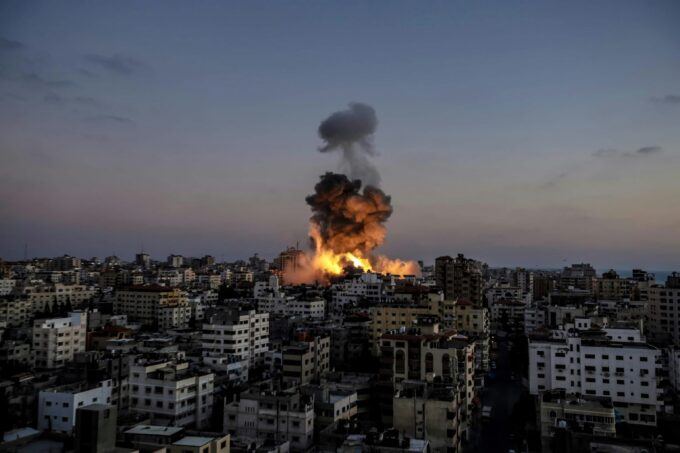
Image by Mohammed Ibrahim.
After protests across Iran turned deadly in January, President Donald Trump promised Iranians that “help is on the way.” On February 28th, the U.S. and Israel launched what immediately became a devastating war on Iran. American and Israeli warplanes began dropping bombs on a country of some 93 million people. Trump soon put out a video address, telling Iranians that “the hour of your freedom is at hand.” Around the time that video appeared, Iranians in the city of Minab were sorting through the corpses of more than 165 people killed in an airstrike on an elementary school for girls.
That same day, an airstrike killed Iranian supreme leader Ayatollah Ali Khamenei, an 86-year-old who was supposedly already in poor health. Throughout the ensuing days, American and Israeli attacks struck hospitals, historic sites, and more schools. In response, Iran aimed its drones and missiles at American military bases and allies across the Gulf region.
What kind of help, exactly, did Trump mean?
What Washington calls help is often disastrous and the U.S. has a long history of offering (and refusing) to help Iran. During the Abadan Crisis of 1951 to 1954, Iranian Prime Minister Mohammad Mosaddegh nationalized the country’s oil industry, which had been under near-complete British control for decades. The United Kingdom responded with a crushing economic embargo, legal challenges, and a naval buildup off the Iranian coast. Mosaddegh repeatedly appealed to Dwight D. Eisenhower for help, but the American president declined to step in.
Some two weeks later, the CIA toppled Mosaddegh’s government with the backing of the British intelligence agency MI6. In effect, that coup d’état — one of at least 72 the U.S. facilitated or attempted to facilitate globally in the Cold War years — opened the path for Mohammad Reza Pahlavi, the Shah of Iran, to reinstall his monarchical autocracy. In his private diary, Eisenhower reflected that “we helped bring about … the restoration of the Shah to power in Iran and the elimination of Mossadegh… The things we did were ‘covert.’ If knowledge of them became public, we would not only be embarrassed in that region, but our chances to do anything of like nature in the future would almost totally disappear.”
The CIA wouldn’t publicly acknowledge its role in the coup until several decades later, but Iranians had little doubt. During his quarter-century reign, the Shah outlawed most political parties, jailed dissidents, and made liberal use of torture. In 1979, a revolution unseated the Shah, but the Islamic Republic that followed only continued his practice of mass repression, torture, and extrajudicial killings. Later, when Iran and Iraq went to war in 1980, the U.S. clandestinely gave each side enough support to ensure neither could win. Worse yet, at the tail end of that conflict, American intelligence officials provided the Iraqi regime of Saddam Hussein with the positions of Iranian soldiers, despite Washington’s knowledge that Hussein intended to use chemical weapons on them.
Donald Trump has long styled himself as distinctly anti-war, but both of his administrations have kept Tehran squarely in their crosshairs. An American president, after all, is still an American president. Since returning to office in January 2025, he has relaunched the long, lethal American tradition of military intervention abroad. “We will measure our success not only by the battles we win but also by the wars that we end — and perhaps most importantly, the wars we never get into,” he said during his inaugural speech. Over the next year, though, he proceeded to bomb seven countries, threaten a slate of nations from Latin America to Europe, and even kidnap Venezuelan President Nicolás Maduro and his wife, Cilia Flores. All the while, he bragged of supposedly ending eight wars.
One of the wars the president insists he ended was Israel’s two-year assault on the Gaza Strip. By the time a U.S.-brokered ceasefire came into effect there in October 2025, Israeli attacks on the coastal enclave had, according to the Gaza health ministry, killed more than 70,000 people. The truce, however, proved to be distinctly one-sided. As of early March of this year, the United Nations estimated that more than 600 Palestinians had been killed and more than 1,600 wounded in Gaza since the ceasefire was implemented. In Lebanon, where a ceasefire went into effect in November 2024, the U.N. had tallied more than 15,000 Israeli ceasefire violations and hundreds of deaths as of late February.
In the United States, war is, of course, a bipartisan affair. The Biden and Trump administrations would, for instance, send Israel more than $21 billion in military aid during the first two years of the war in Gaza. On the campaign trail in 2024, Trump would lean into anti-interventionist rhetoric, warning that a Kamala Harris presidency would drag the U.S. into World War III. Harris’s silence on Gaza evidently cost her a significant number of votes and Trump returned to the Oval Office.
Many Trump voters hoped he would avoid foreign entanglements. Instead, he has deepened the U.S. involvement in conflicts abroad, while deploying federal troops domestically to fight what he’s called an “invasion from within.”
So, the war machine now chugs ahead here and elsewhere, with Trump tightening his authoritarian grip at home, while searching for new conflicts abroad. When Iranians rose up in January, their regime killed thousands of protesters. Trump decried the “killers and abusers” in Tehran even as his masked immigration agents were assaulting protesters and immigrants in Minnesota and beyond. In fact, just a few weeks after an Immigration and Customs Enforcement agent fatally opened fire on the poet, protester, and mother Renee Good in Minneapolis, Border Patrol officers shot and killed a protesting nurse, Alex Pretti, in the same city.
That the president doesn’t care about human rights is obvious, but he took that position a step further when, around the time of Pretti’s death, his administration forced about a dozen Iranians onto a deportation flight back to the very country he had criticized for wanton murder in the streets.
Some help.
Arrests, Torture, and Abuse
“Every empire,” the late Palestinian academic and literary critic Edward Said once wrote, “tells itself and the world that it is unlike all other empires, that its mission is not to plunder and control but to educate and liberate.” As someone whose family had been among the hundreds of thousands of Palestinians violently displaced and forced into exile by Israel’s 1948 establishment in what Palestinians called the Nakba, or catastrophe, Said was speaking from personal experience.
For nearly eight decades, Palestinians living under Israeli military occupation have paid the price of American “help.” Since 1948, the U.S. has sent an estimated $300 billion (when adjusted for inflation) in foreign aid to Israel, much of it in the form of weaponry to the Israeli military. At the same time, the U.S. Agency for International Development gave the West Bank-based Palestinian Authority more than $5.2 billion between 1994 and 2018, and the CIA worked closely with Palestinian security agents.
While living in Palestine from 2011 until 2015, I often thought about the constant flow of American financial and military aid into the region. I worked then as a journalist and, for part of the time, taught at a Palestinian high school in Ramallah. Wherever you looked, the human fallout of what Washington calls “help” was plain to see. For Palestinians in the West Bank, threats came from every direction. Israeli soldiers shot and killed Palestinians on the streets, at protests, or at checkpoints like the ones many of my students had to pass through every day to reach school. More than 730,000 Israeli settlers live in colonies across the territory, and the most hardline among them routinely attack Palestinians, vandalizing their homes and burning down their olive fields. (In one case in 2014, a group of settlers kidnapped and burned to death a Palestinian teenager named Mohammed Abu Khdeir.) Even the Palestinian Authority, ostensibly meant to represent Palestinians, arrests and tortures political opponents, even in some cases carrying out extrajudicial killings.
When Israeli Prime Minister Benjamin Netanyahu appealed to Iranians in late February, it brought my mind back to my time in Palestine. Netanyahu urged them to “cast off the yoke of [their] murderous regime,” denouncing that country’s security forces for killing “thousands of children, adults, and elderly people in cold blood.” Then he added: “Tens of thousands [of Iranians] were arrested, tortured, and abused. And why? Simply because they sought lives of freedom and dignity.”
I thought, freedom and dignity? What about arrests, torture, abuse, and cold-blooded killing?
From the time he first became prime minister in 1996, Netanyahu has served a combined total of more than 18 years in office, while presiding over four of the five wars in Gaza since Israel launched Operation Cast Lead in late 2008. The first four of those wars alone killed more than 4,000 Palestinians in the Strip.
Netanyahu was serving his second term as prime minister in 2014, when the nonprofit rights watchdog Defense for Children International – Palestine hired me to research and write a report about the situation of Arab children living near Jewish settlements in the occupied West Bank. For several months, when school let out each day, I rushed off to travel around the territory, interviewing children and their families and listening to their experiences of arrest, torture, abuse, and cold-blooded killings.
In East Jerusalem, a 14-year-old boy filled me in on how Israeli intelligence had arrested him a year earlier. They accused him of throwing stones, a charge he denied, and set about interrogating him. While trying to coerce a confession, the boy told me, one interrogator grabbed a broomstick and threatened him. “You want me to shove this stick up your ass, so you’ll feel pain and tell me the truth?” the interrogator said (according to the child). The boy finally confessed when the interrogator vowed to have his family’s home demolished.
About 20 miles south of East Jerusalem, I visited a family who lived in Hebron’s Old City. The area is home to several Israeli settlements and a large military presence that severely restricts Palestinian movement there. One of the children, a young girl, recalled a day when she was seven. As she made her way home from school, a group of settlers snatched her off the street. They held her down and set her hair on fire. A year passed before she could sleep through a full night, her parents told me. Two years after the attack, she still wore a hat wherever she went. Her brother, who was then 12, had similarly disturbing stories. A year earlier, an Israeli soldier had stopped him at a checkpoint and accused him of throwing stones. The soldier then slapped him, the boy said, and threatened to kill him. Noticing that I was shaken, his father put his palms up. “Everyone in this house has been attacked before,” he said.
Such stories piled up by the dozens: Molotov cocktails and stones crashing through the windows of Palestinian schools; soldiers firing tear gas and rubber-coated bullets at children; families rushing their young kids from their burning homes in the middle of the night. Then, one day in May 2014, not long after I finished the report, several of my students showed up to class wearing T-shirts emblazoned with the face of a Palestinian teenager who had been shot and killed the week before. His name was Nadim Nuwara, and he had been 17 when a bullet hit him at a protest near Israel’s wall on the West Bank. (Another teenager, 16-year-old Muhammad Abu al-Thahir, was shot and killed in nearly the same spot around an hour later.)
The Israeli military initially denied involvement in the boys’ slayings. Spokespeople told reporters that Israeli forces had not used live ammunition in the area on the day the killings took place. Some suggested that a Palestinian sniper might have shot the kids. When video footage later emerged, the military claimed it was likely “forged.” I drove over to the Nuwara family’s home one day that week and met his parents. They were grieving, but they wanted to correct the record. They had found the bullet that killed their son. After passing through his body, it had been stopped by a textbook in his backpack. We measured the bullet and took photos, and I sent them to a ballistics expert. Unsurprisingly, he confirmed that the bullet appeared to have been made by Israeli Military Industries and was of a kind in active use by Israeli forces.
Israel continued to deny its involvement in the boy’s death, but amid mounting evidence, in November 2014, an Israeli border policeman was finally charged with manslaughter. A subsequent plea deal stipulated that he would serve nine months in prison. By then, I had left my job at the school and was reporting in Gaza. Israel had waged a 51-day war on the Strip over that summer and it lay in ruins. The U.N. had already tallied more than 2,200 Palestinian deaths, 551 of them children. East of Gaza City, I walked with a Palestinian colleague along a residential street in the Shujayeah neighborhood. Both sides of the street were lined with destroyed homes. All that remained standing of one house was a single wall, propped up on rubble. On it, someone had spray-painted: “All This Family Killed by USA Weapons.”
“Help Has Arrived”
This is the second time Israel has gone to war with Iran since Trump, who pulled the U.S. out of the Iran nuclear agreement during his first term, returned to office last year. In June 2025, Israeli warplanes rained down bombs across that country for 12 days. Iran responded with missiles and suicide drones. That bout of fighting killed more than 430 civilians in Iran and at least 28 people in Israel before it ended. The U.S. also joined in, launching a series of strikes on the country, and the president boasted that the attacks had “completely and totally obliterated” the Iranian nuclear program.
Last October, Trump included that war on his list when he took credit for ending “eight wars in eight months.” After Trump and Netanyahu again went to war with Iran this February, the American president offered new justifications. In addition to vowing to help persecuted Iranians, he said that the regime was building missiles that “could soon reach the American homeland,” a claim U.S. intelligence reportedly denied. He also cited a supposedly “imminent” Iranian attack and mentioned the same nuclear program he had previously said was destroyed.
In the United States, few people believe the war is justified. An NPR/PBS News/Marist poll found that more than half of the respondents believed Iran posed at worst a minor threat or no threat at all. Even among pro-MAGA media figures, including several prominent ones like Tucker Carlson and Megyn Kelly, have railed against the president. “It’s hard to say this, but the United States didn’t make the decision here,” Carlson said. “Benjamin Netanyahu did.”
The real reason Trump has shed his former claims to anti-interventionism, though, is history. Since 1776, according to the Military Intervention Project of the Center for Strategic Studies at Tufts University, the United States has intervened militarily in foreign countries nearly 400 times. Since September 11, 2001, U.S.-led counterterrorism operations have reached at least 78 countries. As of 2021, the U.S. had spent more than $8 trillion on its Global War on Terror, a series of conflicts that the Cost of War project at Brown University estimates to have killed at least 900,000 people. Meanwhile, the Pentagon’s budget has reached $1 trillion and defense contractors continue to pump tens of millions of dollars into lawmakers’ pockets each election cycle. With a record like that, what help can an American president really offer Iranians living under a repressive regime?
For my part, each new report of an American or Israeli airstrike hitting a home, a hospital, or a school in Iran brings back another memory from my years living in the West Bank. After a bullet cut Nadim Nuwara’s life short in the late spring of 2014, I was sitting in his family’s living room when his little brother came in. He was 10, small and gentle-voiced, and wore a backward hat. He held up a large photo of his brother. “I thought this summer was going to be very fun with my brother,” he told me. “I thought Nadim and I were going to be able to play together a lot. But he’s gone now and this is going to be a very bad summer.”
During the first 24 hours of this latest war alone, U.S. Central Command’s Brad Cooper announced in a video on X that the scope of the assault on Iran was “nearly double the scale” of the first day of the invasion of Iraq in 2003. On the first day of the war, Benjamin Netanyahu released another video in which he directly addressed Iranians. “Your suffering and sacrifice will not be in vain,” he insisted. “The help you have prayed for, that help has arrived.” And then the slaughter continued.
This piece first appeared on TomDispatch.
The post Why Donald Trump Just Can’t Stop Going to War appeared first on CounterPunch.org.
From CounterPunch.org via this RSS feed
20

Photograph Source: The White House – Public Domain
Jason Furman is a very good economist, but sometimes he gets some things wrong. His NYT column, saying the Trump and Biden economies are largely the same, is in that category.
Before saying what I think he got wrong, let me mention some very big things he got right. First, people do hugely overrate the impact of a president on the economy. The big things that happen to the economy are usually beyond a president’s control, like Covid or the OPEC price shocks in the 1970s. Nonetheless, the person in the White House tends to get blame or credit.
Second, there is obviously a large element of partisanship in people’s views of the economy. When Democrats see a Democrat in the White House, they tend to say things are good, and bad when there is a Republican. These partisan swings have gotten larger in recent years, and they tend to be bigger for Republicans than Democrats. Jason is on the money there but let me mention a few places where I think he missed the mark.
Harris Did Not Cheerlead the Biden Economy
First, I think he is very unfair in saying that former VP Kamala Harris was running around touting that the U.S. economy was the envy of the world. This claim was in fact true, but that was hardly the main story of her campaign.
Harris went around everywhere saying that she knew people were hurting and outlined proposals, especially on housing, on how she would make things more affordable. We can debate the merits of these proposals, but she was quite explicitly trying to address what she said were major problems in the economy.
I remember this well because I was haranguing people that I knew in the Biden administration that they should be boasting more about their economic achievements. They turned around an economy that was flirting with recession when Biden took office and went on to have the longest stretch of low unemployment in 70 years. Real wage growth for low paid workers was the best in more than half a century. There was an unprecedented boom in factory construction. I said at the time, and would say again, that Trump would have called it “the greatest economy EVER,” if it had happened under his watch.
Anyhow, this is all water under the bridge at this point, but it is simply unfair to say that Harris and the Democrats were blindly touting the great economy prior to the election. There was much more there to tout than they claimed credit for.
Did the Economy Turn for the Worse Under Trump?
Jason shows the data and it is hard to make a case that the economy had a terrible year in 2025, although I think there is a case it had a turn for the worse. I’ll start with a nerdy point that means nothing to most people, but it means a lot to nerds like Jason.
The inflation rate was headed lower and was generally projected to hit the Fed’s 2.0 inflation target in 2025, or be within spitting distance of it. This was a remarkable achievement, since it meant that the inflation rate was brought down from pandemic peaks of more than 8.0 percent with only a very limited rise in unemployment. Few economists thought that was possible.
Most people are not following inflation projections closely, but they do still have a general sense of what a policy of tariffing everyone everywhere means. This is easy to see in the data. Consumer spending on durable goods (items like cars and cameras, much of which is imported) jumped 3.8%, a 25.1% annual rate, in the two months immediately following the election.
This surge in spending on durable goods reversed the trend of declining durable goods prices, which led to the modest increase in the inflation rate in 2025, instead of the decline that had been widely projected under Biden. It is probably also worth mentioning that the last pre-war inflation data suggested a further acceleration, which will be worsened markedly by soaring energy prices.
The unemployment rate has also edged higher. The current rate of 4.4% is not high by historical standards, but it is markedly worse for disadvantaged groups. The unemployment rate for Black workers is 7.7%, up from 6.2% when Biden left office. The unemployment rate for young workers, between the ages of 20-24, rose rapidly in 2025, peaking at 9.2% in September, although it has fallen back down to 7.4% in the most recent data.
The labor market is also weaker by other measures. The quit rate has fallen to 2.0% from a peak of 3.0% in spring of 2022. In fairness, that quit rate was likely unsustainable and the decline took place in 2023 and 2024, but the 2.0% rate is low for an unemployment rate of 4.4%. In the years just before the pandemic, when we had a strong labor market, the quit rate averaged 2.3%. You would have to go back to early 2016, when the unemployment rate was 5.0%, to find a quit rate of 2.0%.
In some respects, quit rates are a better measure of the state of the labor market than the unemployment rate. In a normal month, more than 3.2 million people leave their job, which comes to nearly 40 million on an annual basis. (Some people quit more than once over the course of a year.)
For tens of millions of people, the opportunity to quit means being able to leave a job that was boring, stressful, or offered little opportunity for advancement. For these people, the inability to quit and easily find another job means a bad labor market, even if the unemployment rate is low. In fairness, the drop mostly took place under Biden, but the longer it lasts, the more people feel stuck in a job they don’t like.
It’s also worth noting in this respect that the pace of nominal wage growth has slowed some in the last year and a half. Using the Average Hourly Earnings series, growth slowed from a bit over 4.0% to 3.7% year-over-year in the most recent data. In the Employment Cost Index, it slowed from a bit over 4.0% to 3.5%. These are not sharp slowdowns, but they are consistent with a weakening labor market.
Affordability and That Stuff
I confess to having been a skeptic about all the complaints on “affordability” in the last couple of years. Being a card-carrying economist, I look at real wages and real income, which are both up, and then ask, “what’s the problem?” I also had my skepticism stoked by the parade of people on Twitter who were working two or three jobs but still couldn’t afford to put food on the table. They all disappeared after the election.
But the complaints have persisted, and polls consistently show that people do not feel good about their economic situation. A possible explanation for the gap in real wage and income measures is that our measures of healthcare inflation bear almost no resemblance to the rise in healthcare costs that people actually see.
The measures of inflation look at the change in prices for specific items, like a particular drug or medical procedure. My guess is that most people are concerned about what they pay for healthcare in the form of insurance premiums, co-pays, deductibles, and other out-of-pocket costs. Spending on healthcare has risen more than twice as fast as the Consumer Price Index’s measure of inflation.

How much of this is borne by households depends on the extent to which payments by the government or employers have increased in step with these cost increases. My guess is that they haven’t, which would mean the health care cost increases seen by households would be even more rapid. With healthcare accounting for 8.5% of people’s spending, this would imply a substantial gap between the inflation people experience and the CPI measure of inflation.
This may not be the sole cause of complaints about affordability, but it likely is a big part of the story. Again, this is not something that started when Trump took office, but households are almost certainly paying a larger share of costs under Trump than they were under Biden, especially with the end of the enhanced subsidies for the Obamacare exchanges.
There is one other factor worth mentioning in this comparison. The conditions for repaying student loan debt have worsened markedly under Trump as he has rolled back Biden’s generous income-driven repayment plan. The pandemic moratorium on payments has ended and millions of people are now delinquent or in default on their loan debt. With over 40 million people owing debt on student loans, this is a large group of people who have good cause for thinking the economy is worse under Trump.
The Real Story is the Long-Term
The biggest impact of the difference between Biden and Trump policy is likely to be a long-term story. While Biden had implemented a number of measures to hasten the transition to electric vehicles and clean energy, Trump is doing everything he can to lock us into fossil fuel dependency. As the cost of EVs and clean energy continue to decline rapidly, this decision will be costing us more money through time. It also means the United States will be largely locked out of these important growth sectors. And this is besides from the additional damage we will be doing to the environment.
Trump’s policy on immigration will certainly slow growth. Also, his harassment of universities and researchers will likely lead to many scientists deciding to work elsewhere. The United States will be a much less important source of innovation going forward than it was in prior decades. This is a bad story for the U.S. economy, even if it may not be what people have in mind when telling pollsters the economy is bad.
And the war in Iran is almost certainly to lead to long-term damage. At this point, it’s hard to have much idea of what the endgame looks like, but this attack has done even more than tariffs to leave the United States isolated. That is not a good long-term story.
In short, at least until the war, the effect of Trump’s policies on the economy may have been negative, but they were not disastrous. The longer-term picture is considerably worse.
This first appeared on Dean Baker’s Beat the Press blog.
The post Are the Trump and Biden Economies the Same? appeared first on CounterPunch.org.
From CounterPunch.org via this RSS feed
21

Jessica Mitford on After Dark, August, 1998.
I did not know Jessica Mitford— who was dubbed “the Queen of the Muckrakers”– for long, but I knew her well. In the 1990s, shortly before my biography of Abbie Hoffman was published I decided that I wanted to write a biography of “Decca,” as she was known. I had met her in 1984 when I invited her to speak in a lecture series at Sonoma State University (SSU) devoted to George Orwell’s dystopian novel, 1984. I remember that she talked in a large classroom to the students and a few faculty members about the time that she was hired to teach at San Jose State University SJSU, a part of the California State University (CSU) system. She was required by the administration to provide her fingerprint to the campus police and swear to uphold the Constitution.
(At SSU, she also held a seminar and shared some of the tips necessary for a muckraker. What was essential, she said, was to create a blueprint that would show the author how the story would be written, the main sources, the audience and the style or tone. All the above before the writer wrote the lead or even provided a working title for the piece. Good advice!)
The whole rigmarole with the SJSU administration reminded Decca, she explained, of McCarthyism, which she knew all too well, along with the loyalty oaths and the kind of police state envisioned by Orwell in his novel, which American liberals insisted offered a portrait of the kind of totalitarian state that existed in the USSR. Decca wasn’t as sure as they were. She thought, as I did, that the world of Big Brother also applied to England and the US. Orwell hedged, though his experiences at the BBC provided him with ammunition when he sat down to write his novel. As Decca knew, the so-called “Free World” could be as totalitarian as the world behind the Iron Curtain.
In 1984, I was teaching in the English Department at Sonoma State University (SSU). When I was hired, I was required, as Decca was, to surrender my fingerprints and pledge my allegiance. If I did not do so the university president told me I would not be paid. So I gave my fingerprints to the campus police and swore allegiance. This was immediately after I was interviewed for a teaching position as a lecturer and was asked what I hoped the students would learn. “A sense of dignity,” I told the committee. I was no doubt thinking of myself as well as the students and felt that the obligation to provide fingerprints stripped me of some, albeit not all, of my dignity.
Decca wanted to protect her fingerprints and preserve her First and Fifth Amendment rights. As she explained to the 1984 audience, she battled the president of SJSU, but then gave in and cooperated, as far as her fingerprints were concerned, though she was not proud of her acquiescence. McCarthyism wasn’t dead and buried, she insisted. Indeed, it could return at any moment.
To persuade Decca that I was a suitable candidate to write her biography, I drove to her home in Oakland on a warm morning, met her husband Bob Treuhaft, a lefty lawyer, and handed her a copy of the manuscript of my Abbie biography, which had not yet been published. Decca announced that she was taking me to lunch at Oliveto, an upscale restaurant close by. Soft shell crabs were in season and she was eager to order them from the menu. So was I. Then she waved a check in front of my face. It was from a funeral director’s organization in New Jersey and to the best of my recollection, it was made out to Jessica Mitford for $15,000.
There was a back story. An underling at the New Jersey funeral directors association had invited Decca to speak at the annual convention, not realizing that her best-selling book, The American Way of Death, was a take-down of the whole funeral industry. When a superior learned about the invitation, he fumed and fussed and canceled the invitation. Decca swung into action, which was what she loved to do. She didn’t “steal this funeral,” but she did something that the author of Steal This Book might have done. She enlisted the help of her husband, who brought a lawsuit against the funeral directors and pointed out that they had signed a contract with Jessica and that she was entitled to a percentage of the fee she was to be paid.
A check soon arrived in the mail. Once it was cashed, Decca and I headed to Oliveto and feasted on soft shell crabs and drank a bottle of chilled white wine. Then events happened fast and furious. I was hired to teach full-time in the communication studies department at SSU. Soon afterward, when the Soviet Union fell in 1991, I called Decca to check in with her. My Abbie Hoffman book still had not yet appeared in print.
A long-time supporter of the Soviet Union, Decca insisted that its collapse was one of the great tragedies of the second half of the 20th century. She was a communist to the bitter end. I knew old lefties who felt the same way she did. For them, the demise of the Soviet Union was the end of an era and the culmination of history that started in 1917 with the Russian Revolution.
Decca died in 1996. I was too busy teaching and revising my Abbie biography to consult with her on the book about her that I wanted to write. When I read about her death, I contacted Bob Treuhaft, who told me that Decca had read my Abbie manuscript and on the last page wrote, “I do not want Jonah Raskin to write my biography.” It was like a voice from the grave. At the time, I didn’t really understand why she came to that conclusion.
Now, having read Carla Kaplan’s comprehensive biography, Troublemaker: The Fierce, Unruly Life of Jessica Mitford (Harper; $40), I have a much better idea. I think that Decca did not want me to do to her what I did to Abbie Hoffman and what she did to many of the people she wrote about, which was to hold them up to scrutiny and view them through the lens of satire and with a sense of humor. She certainly didn’t want me to mock her or to reveal some of the contradictions in her life as the daughter of wealthy right-wing Brits who didn’t really reject her class privileges but who supported the cause of the poor, the exploited and the oppressed, and along the way denounced the American penal system. The US version of the Gulags.
What Decca didn’t want me to do, Carla Kaplan has done in Troublemaker. It’s true that Kaplan’s book veers on hagiography, but it also exposes the rough patches in Decca’s marriage to Treuhaft, her dramatic mood swings, alcoholism, attraction to fame and fortune, her fierce attachments to her beloved fans and her breakups with long time lefty friends like Marge Franz, a union and working class organizer with a belief in feminism, a cause that had little if any appeal for Decca.
In the chapter “Writing About the Dead,” Kaplan notes, “Decca was a loyal person, and not very sexual.” What the hell  does that mean? And why do we have to know anything at all about the role that sex did or didn’t play in her life? Beats me.
According to Kaplan, Franz thought that Decca had sold out. The evidence suggests that she frittered away her talents by writing travel pieces, book reviews and fluff for which she was well paid. After all, a writer has to live. One becomes addicted to seeing one’s name in print. That was true for Decca.
Kaplan gets a lot that right in Troublemaker, but she gets a lot that’s just plain wrong. In the chapter titled “The Making of a Muckraker,” Kaplan writes, “as much as Decca loved being admired, she thrived on being attacked.” In fact, as Troublemaker makes abundantly clear, she loved to go on the offensive and to attack, attack, attack, whether it was against the funeral industry, the US penal system or institutions and organizations that deceived and bilked the public.
She thought that many young reporters didn’t go for the jugular, as she did. There’s some truth in that view. Some magazines, including Mother Jones, wanted to capitalize on Decca’s fame and urged her to “make more of herself” in her articles. She couldn’t replicate herself or improve on the book that made her famous.
Indeed, The American Way of Death was and still is a masterpiece of reporting. It not only exposed the funeral industry. It also revealed the American fascination with death and dying, just as American soldiers and the Vietnamese began to die on battlefields and Pentagon body counts lied.
I have not had much sympathy for the three Weathermen who blew themselves up in March 1970, but Decca’s reactions to that event and later specifically to Kathy Boudin’s role in the attempted robbery of a Brinks Armored Vehicle in 1981 were over the top and totally lacking in empathy.
To Black author, Maya Angelou, Decca wrote, “Kathy has managed in one deft moment to rehabilitate the discredited FBI, possibly ensure passage of the ‘terrorist’ bill which would re-establish HUAC in a new and more palatable form, plus senseless murdering of the three people.” Kaplan quotes from that letter on page 396 and provides a footnote. Decca added that Boudin’s actions were “WICKED and STUPID.” “Stupid,” yes, but “wicked?” Probably not. “Wicked” sounds very British and upper-class.
In some ways, Decca’s reaction to the Brinks’ job was typical of some, though not all, Old Leftists who saw agent provocateurs under every bed and around every corner and were eager to denounce what they called, after Lenin, “Leftwing Communism: An Infantile Disorder.”
As Kaplan shows, Decca was sympathetic to Dr. Benjamin Spock and the anti-war activists known as the “Boston Five” who were on trial for conspiracy, but she doesn’t seem to have been sympathetic to the New Left and the women’s liberation movement. In curious ways, she was stuck in the past; her politics had been formed in the 1930s, and especially by the Spanish Civil War, when for a time the only two meaningful choices in the political world seemed to be between Communism and Stalin on the one hand, and Fascism and Hitler on the other hand.
Some of Decca’s own family members were pro-Hitler. Her mother was devoted to the Führer. “Nazism is from every point of view preferable to Communism,” she wrote. Sister Unity Mitford adored Hitler and became part of his inner circle. As Kaplan rightly points out, “Many British aristocrats had fascist sympathies.” Churchill wanted Hitler and Stalin to destroy one another and for the British Empire to reap global rewards.
Mitford saw through that horrendous British upper-class identification with the Nazis; she was a lifelong anti-fascist and not only premature but right on time. For that stance, I admire her greatly. I also admire her doggedness as a reporter, her willingness to do most anything to get the story, even if it meant going underground and adopting “unethical” practices. To fight corporations, one had to be down and dirty, she insisted. That’s what she told me again and again. I agreed with her and still do.
Decca rejected the cult of so-called “objectivity” and joked, “I’ve always had an objective.” In that way, she was part Yippie. And Abbie Hoffman was part Decca, especially in the essays he wrote when he was a fugitive and that he published in Square Dancing in the Ice Age.
(Two Yippie friends, Judy Gumbo and Stew Albert, named their daughter after Mitford; their Jessica carries on her legacy. Decca lives!)
My favorite black-and-white photo in Kaplan’s book shows Decca holding an elegant “Muckrake” which is totally appropriate given her role as the “Queen of the Muckrakers.”
Still, Kaplan might have placed Decca in the lineage of the two queens of muckraking who preceded her: Ida Tarbell, who exposed Rockefeller and Standard Oil; and Ida Wells, the African-American journalist who told the much-needed, long-buried story of the lynching of Black men in America. Decca stood on their shoulders. Is there anyone who has taken up her mantle today? I hope so. In hindsight, I’m glad I never did write Decca’s biography.
Kaplan has done a far better job than I ever would have done. She mentions the project, “Senda Piana to Havana,” launched by Decca’s son, Benjy, meant to defy the embargo and ship pianos to Cuba. Decca told me that she was exceedingly proud of Benj’s campaign and that she aided and abetted him. The role of the apolitical journalist was not for her.
The post Jessica Mitford and Me appeared first on CounterPunch.org.
From CounterPunch.org via this RSS feed
22
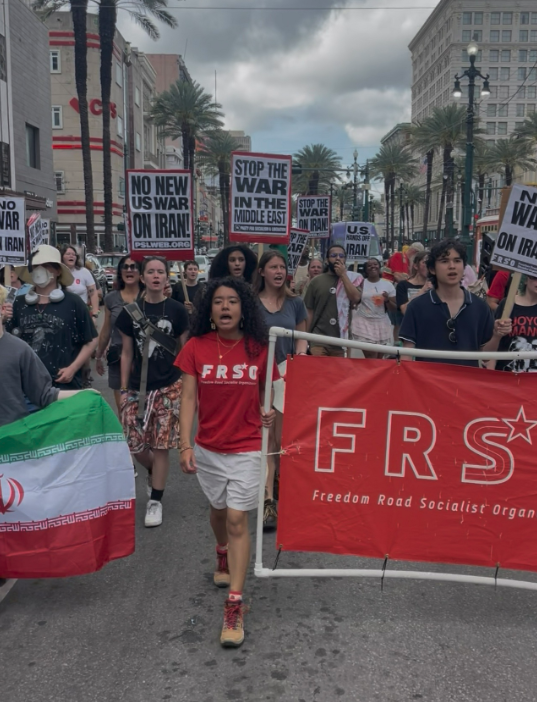
New Orleans, LA – On Sunday, March 15, the Anti-War Action Network (AWAN) and New Orleans Stop Helping Israel’s Ports (NOSHIP) held a rally in front of Jackson Square condemning the U.S.’s attacks on Iran. 40 community members and activists rallied at Jackson Square and marched through the New Orleans French Quarter and back to Jackson Square once again.
“When the U.S. and Israel carried out a mass extermination campaign against the Palestinian people, Iran was one of the only countries in the world to stand with the Palestinian resistance,” said Silas Gillett of the Freedom Road Socialist Organization. Gilbert continued, “FRSO is here today to stand side by side with Iran in fighting back against U.S. imperialism.”
Warren Tustix from NOSHIP ended his speech with a call to the crowd, “We say no to Western imperialism, to big oil selling death around the world, to the U.S. global AI war machine, to war with Iran, and to war anywhere!”
While marching down the historic tourist-packed Bourbon street, the crowd chanted “No boots on the ground, no bombs in the air. U.S. out of everywhere!” and “From the belly of the beast, hands off the Middle East!”
#NewOrleansLA #LA #AntiWarMovement #Iran #AWAN #NOSHIP
From Fight Back! News via this RSS feed
23
1
Scale Raises the Ceiling, But Fiscal Foundations Determine Whether Autocracy or Democracy Prevails
(www.counterpunch.org)
24
25
Apulian red figure amphora. Antigone, second from left with bound hands, is led to prison and death. ,Vase about 350-340 BCE. Berlin Altes Museum. Photo: ArchaiOptix, Wikipedia.
Antigone was the daughter of Oedipus, King of Thebes. After the dramatic end and disappearance of her father who had blinded himself, her uncle Creon succeeded to the throne. Antigone’s two brothers, Polynices and Eteocles, fought and killed each other. Creon issued an order forbidding the burial of Polynices because he fought against Thebes. Antigone rebelled against her uncle and his order. Her courage made her an iconic heroine with influence lasting to this day.
War and declining freedom
“In the first few months of 2026,” says Helen Shaw, theater critic for the New York Times, “Antigone is visiting New York four times, in four different stage adaptations. (Her omnipresence is like a rush of white blood cells — there’s an infection somewhere in the body politic.)… Sophocles was writing when both theater and democracy were young; the secrets of each are embedded in the play. At its deepest point, the tragedy warns us not to obey only a single ethos.”
True, the infection is that of the illegal war the US and Israel are fighting against Persia / Iran. Israel led Trump to this war. But the US has made war almost a business and industry. According to the journalist Patrick Strickland:
“Since 1776… the United States has intervened militarily in foreign countries nearly 400 times. Since September 11, 2001, U.S.-led counterterrorism operations have reached at least 78 countries. As of 2021, the U.S. had spent more than $8 trillion on its Global War on Terror, a series of conflicts that the Cost of War project at Brown University estimates to have killed at least 900,000 people. Meanwhile, the Pentagon’s budget has reached $1 trillion and defense contractors continue to pump tens of millions of dollars into lawmakers’ pockets each election cycle.”
This war-business as usual becomes a devouring monster of freedom of speech, economics, morality, politics and the future of democracy. Without a third party strong enough to challenge both war Democratic and Republican parties, what could a citizen do? In addition, the close and strong alliance between US and Israel is not quite a normal connection. “By fully joining a partner that is reconciled to endlessly fighting,” says Jon B. Alterman of the Center for Strategic and International Studies in Wahington, DC, “United States has given up its most valuable role in the Middle East: the outside power with a wide array of economic and diplomatic tools that Israel needs precisely because it stands apart. What was once a win-win has the markings of a lose-lose. Future administrations may find themselves spending years picking up the pieces of an alliance that they conclude grew too close.”
The result of that “close” US-Israel relationship brought us war and fear. Too much fear. The fear of losing our freedom explains the “omnipresence” of Antigone in New York theaters. Hence, the resurrection of the Greek heroine Antigone who told her uncle tyrant Creon he did not know what he was doing in ordering that no one had the right to bury Polynices. She said to Creon that ignoring the gods and their divine traditions was not a good idea. She argued eloquently that those sacred traditions were forever.
That audacious daring and courage — risking her life in defense of freedom and the divine tradition she inherited — makes her a superheroine. In an age of historical amnesia, cowardliness and plutocratic politics and governance and silence, Antigone leads the way.
What Helen Shaw calls ethos, Sophocles meant the tyrannical law of Creon, ancle of Antigone and King of Thebes. Creon declared that Antigone’s brother Polynices did not deserve burial. His body would be left for dogs. Such an order profoundly unsettled Antigone and increased her suffering. She decided she had to bury her brother’s body, even symbolically. Sacred laws and traditions demanded that respect for the dead. And the dead man was her own brother, doubling her suffering and responsibilities. She secretly found her brother’s body and poured over it some soil, thus symbolically buried and honored her dead brother. However, the news that Antigone had “buried” her brother reached Creon. The king confronted Antigone but she had no apologies for her action, which, she said to her ancle, was the fulfillment of a sacred law of the gods. She made clear to Creon that the sacred law for burying the dead superseded his or any other human law (Sophocles, Antigone 450-459).
Creon found the behavior of Antigone not only illegal but offensive to him personally. Acting not as an uncle but like a tyrant, he condemned Antigone to death by entombing her in a room to die slowly by starvation. His son, Haemon, however, was in love with Antigone. Unable to free Antigone, he committed suicide, thus compounding the tragedy of Antigone.
Epilogue
Sophocles said the world was a very dangerous place. Man, he repeated in his tragic and political play, Antigone, was the fiercest of all animals. Yet man, he wrote in his Trojan War play, Philoctetes, had precarious fortunes and plenty of misfortunes. Man was danger. That’s why Sophocles sought confidence and strength from the old culture of the Greek people and their gods in particular. They were permanent because they had passed the test of time. If only the Greeks could conquer their own Troy, they would be in a position to continue with their reverence for the gods and enjoy the world of their own making. Their freedom would be secure. That was the essence of Sophocles — and of all Greek tragedy.
Americans are far removed from the Greeks. But the extraordinary conditions of the war against Iran and the consequences of the decline of freedom may inspire us to get closer to the Greeks. We can learn from their ceaseless passion for freedom, science and civilization.
The post The Virtues of Antigone appeared first on CounterPunch.org.
From CounterPunch.org via this RSS feed
view more: next ›