31
Inuit woman and three children (plus dog) in winter, Nunavut, Canada, 1956
(upload.wikimedia.org)

Sorry, I'm not sure what you're asking about exactly here?
"I'm gonna rumble with the ecosystem."
"Damn, ecosystem got hands" - Humankind for most of our existence
It's pretty good, I've played it! A rare decent usage of FMV in a modern game, too.


Ishtar gave them wings
It’s at best dishonest to actually believe Abraham Lincoln was against slavery.
The only uniting policy of the Republican Party of the time was anti-slavery policy. That's why they replaced the Whigs.

Nothing is more noncredible than real life, it would seem.
Explanation: During the English Civil War, a conflict between Parliamentarian and Royalist forces raged across the country. Eventually, Parliamentarian forces, themselves dominated by radical protestants known as "Puritans", would prevail in the war, with their primary military leader, Oliver Cromwell, ascending to power.
Unfortunately, Cromwell was the worst mixture of radicalism - none of the pro-democracy or proto-socialist sentiment common amongst Parliamentarian radicals, all of the religious fanaticism! He dissolved parliament and ruled as a dictator, enforcing measures against "popery" like "entertainment", "Fun", and "Irish people being alive".

Explanation: The Carthaginian Republic, the Phoenician colony in North Africa, had a concerning tendency to make scapegoats out of its military leaders for any failures incurred by the state. They would often execute said generals for their 'failures'... hardly encouraging to other officers! Part of this is because of the intense regional/protofeudal nature of Carthaginian politics - a good general for the interests of one family was not necessarily good for the interests of the other powerful families - so the moment an excuse came up to 'get rid of' him, permanently, it was taken! Sure, you might lose the war, but at least those filthy political rivals won't be strengthening their holdings in Spain when the war is over!
By contrast, the Roman Republic of the same period was very 'hands-off' about punishing generals even for legitimate incompetence, with the most being afforded, usually, was removal from command and the destruction of their political career and social life.

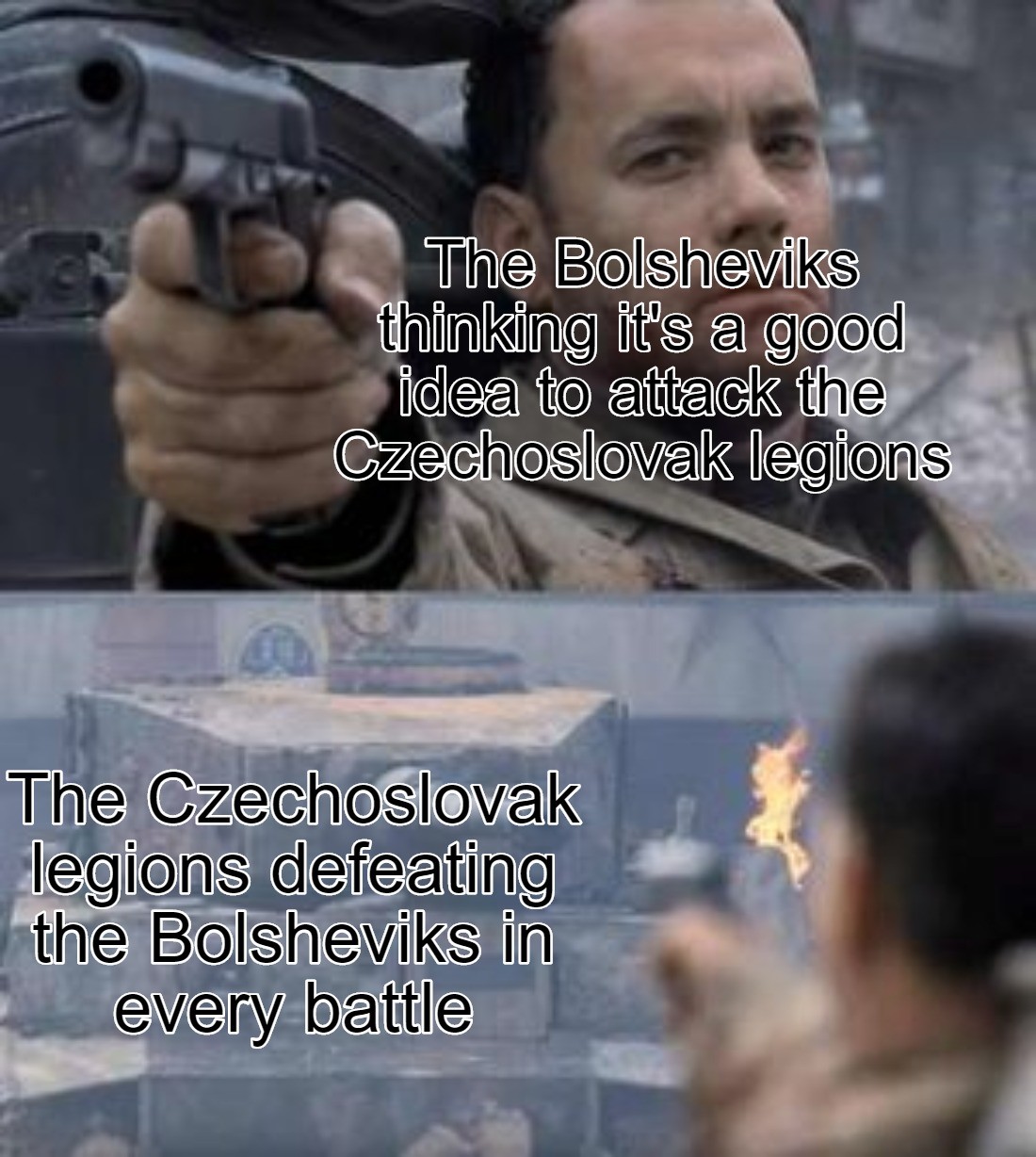
Explanation: The Czechoslovak Legion was a military formation during WW1 that was organized against the Central Powers, in the hopes of earning Triple Entente support for an independent Czechoslovakia.
After the Bolshevik coup of the democratic socialist government of Russia, Russia pulled out of WW1, resulting in the Czechoslovak legionaries in Russia needing to evacuate to continue the fight. Unfortunately, as the ports of European Russia were largely constrained by the positioning of the Central Powers, the decision was made to evacuate the legionaries by the Pacific port of Vladivostok.
The Bolsheviks and Czechoslovaks made an agreement to allow this, under the condition that the Czechoslovaks surrender most of their heavy equipment. The Czechoslovaks agreed. Despite this, the Bolsheviks decided to turn on the Czechoslovaks anyway, attempting first to arrest them, and then to kill them.
Thus began a year-long involvement in the Russian Civil War as the Czechoslovak Legion attempted to cross the country to Vladivostok, evacuation, and, by the time they got to Vladivostok, the safety of a post-WW1 peace and a newly independent Czechoslovakia.
They acquitted themselves very well.


Explanation: During the Battle of Carrhae, a series of mishaps and poor decisions by the Roman commander, Crassus, resulted in the Roman heavy infantry under his command coming under constant attack by Parthian lancers and horse archers. Crassus decided, not completely foolishly, that the Roman infantry could simply outwait the Parthian supply of arrows.
Unfortunately for Crassus, the Parthian commander had planned well in advance for the battle, and had a steady camel train of arrows supplying his archers. The Parthians, uh, did not run out of arrows as Crassus hoped, and the Romans were utterly defeated.
Luckily no military operation since has ever underestimated the logistical capabilities of the enemy. /s
Explanation: During the Battle of Carrhae, a series of mishaps and poor decisions by the Roman commander, Crassus, resulted in the Roman heavy infantry under his command coming under constant attack by Parthian lancers and horse archers. Crassus decided, not completely foolishly, that the Roman infantry could simply outwait the Parthian supply of arrows.
Unfortunately for Crassus, the Parthian commander had planned well in advance for the battle, and had a steady camel train of arrows supplying his archers. The Parthians, uh, did not run out of arrows as Crassus hoped, and the Romans were utterly defeated.
Luckily no military operation since has ever underestimated the logistical capabilities of the enemy. /s

Oh, yeah, generally arbitrary hierarchies, and often even non-arbitrary hierarchies, end up poorly.
In general, human society is a question of balance of power. Once one group's power becomes overwhelming enough that its decisions can't be meaningfully disputed by the victims, increasingly immoral behavior tends to follow. The greater the imbalance of power, the greater the immorality, usually.